Showing posts with label April. Show all posts

Wednesday, April 24, 2013

Night-dark day


Night-
dark day,
dismal drizzle
crying gulls. One boat plows
through mist, hauls weighted
traps, throws star-
fish back.


Notes
This poem is a modified English form of a cinquain,  a form  of syllabic verse in which each line consists of a strict number of syllables (like Haiku, with its 5/7/5 formula).  Initially, in French, cinquains were poems built of five-line stanzas. In English, however, the cinquain developed a specific formula, so that the first and last lines consisted of two syllables, the second four, the third six, and the fourth eight. I added an extra first line here (making a sextain?) for sense and sound.

So foggy today that the day is both dark and blind. The sea star picture was taken on Hakai Beach in Central BC in full sun. We don't have such wildly brilliant starfish on the east coast. But the five points make their point, and add desperately needed light to the day.

Monday, April 15, 2013

Winter galls us


Who can bear how winter clings and stops us at the root?
Nothing in the house to burn save paper scraps and torn up box.
Colour is something memory finds, a gap, an aching loss,
for a world awash in weeviling greys and stinging damp:
mould's heaven, not ours.
We long for sun or a meteor shower,
for a sudden pressing bud, or
the arcs and angles of a swallow's flight.


Who could be content with last year's apples,
or the bitter dregs of yesterday's tea?
Leftover news in a fog-darkened sky.
Like business-as-usual, relentless winter galls us, excoriates hope.
Why live without promises of ripeness, without
a burst of juice between your teeth?


Notes
The echo here is Chaucer of course, the Prologue to the Canterbury Tales.
When will "that Aprille, with hise shoures soote,/ the droghte of March hath perced to the roote"?

Photos were taken in West Quoddy in April 2010.

Sunday, April 14, 2013

April Sunday Morning / moods in falling snow


Risen from the blindness of sleeping to dull light of morning.
Shadows flare and blur. When I find my glasses: sudden sharp edges.
Fat snowflakes gathering in clusters bomb by the windows--
Oh why get up; just let me close my eyes.
But the dog wants breakfast and the fire must be lit, so I stand up.
Waves swarm the harbour and rush into land--
this battle will be lost. Gritty foam scatters on the beach, 
clings to stone, tumbles end over end.
Lately I'm hearing voices as if
the radio's half un-plugged.
There's this song that someone is singing
in a language I can't understand.
In the newspaper, rows of North Korean children holding red scarves.
No one mentions hunger, just missiles, thermonuclear threat, diplomatic talks.
Crows cackle in the snow, but the sparrows do not sing.


Notes
Nearly every day for a period of years, Robert Lowell wrote at least one blank verse sonnet--fourteen lines of dense thought and rhythm, without any rhyme. I break more rules here--hardly following the sonnet form at all (I am a much less able poet than he)-- but do begin with a variation on one of his opening lines, from "Blizzard in Cambridge" (first published in Notebook 1967-8). My title, of course, echoes Wallace Stevens' "Sunday Morning," a long poem built of eight 15-line stanzas. The second part of the title, "moods in falling snow," is a line from that poem.  And for any line that begins, "Lately I....," I am indebted, of course, to Amira Baraka, whose "Preface to a Twenty-Volume Suicide Note" resonates forever.

Pictures were shot through a plastic bag in damp weather, in Marie Joseph and the Liscombe River, on the Eastern Shore of Nova Scotia.


Saturday, April 13, 2013

The Sound of Snow


Why do we wake when we do?

Up at 3:30 (not yet midnight
in Vancouver) my head full of
chores.

Sleet spatters
the windows
snow blankets
the yard our
black roof 
goes white.


Snow slickens decks,
sifts through 
bright cord and
stone-weighted
lobster traps.


The dog
goes on 
sleeping.

Everything 
is quiet,


and then 
the wind
arrives. 

By daybreak,
freezing rain.


Notes

Photographs were taken on the West Quoddy dock this morning in a sudden, freezing downpour. The vertical stacks continue my first efforts, a few days ago, to "tear space open," as photographer David Hilliard puts it. Too windy for a tripod, but perhaps wind blows through some discontinuities rendered here.

In English, the word sound is itself, a cacaphony.  It carries four distinct and major meanings: 1) health; 2) "strait of the sea;" 3) a noise; and 4) to measure a depth of water.  The first of these meanings, health, stems from the Anglo-Saxon word sund, (related to Gesund in German), while other meanings stem from other roots.  "Sound" as a "strait of the sea"--Desolation Sound, for example, in BC--apparently emerges from a different Anglo Saxon word sund, perhaps derived from swum, Anglo-Saxon for "to swim."  In this case, a sound is 1) a swimming; 2) the power to swim; and thus, 3) a strait of the sea that could be swum across. "Noise," perhaps the most typical contemporary use of the word sound, comes to us from French (son), via Latin (sonum), but is also linked, speculatively, to the Anglo-Saxon word swin, or melody. Finally, the use of sound as a verb--"to measure a depth of water"--also emerges from the French sonder, to test or measure the depth of water.  This usage (sondar in Spanish and Portuguese), is thought to come from a marriage, in Latin, between sub- (under) and undare (from unda, a wave). But lexicographers also note the following Anglo-Saxon words: sund-gyrd (sounding rod), sund line (sounding line) and sund rap (sounding rope). Throw me a life-line--I'm not swimming today!

This poem was built of "12 true things," which is to say, a dozen small observations.


Friday, April 12, 2013

Nothing lasts


12 April 2013

Bare branches sweep the sky
sunlight scatters shadow
the radio speaks of snow


Yellow coltsfoot splits a stone
blasted wood slivers, rots
nothing stays, nothing lasts


not 
this cold, not 
this wind, not
that streak of cloud.   


Notes

Photos were taken in Beaver Harbour and Port Dufferin today, before the clouds moved in. The overnight forecast is for 15 centimeters of snow.


Wednesday, April 10, 2013

Why is poetry an emergency?


10 April 2013

prose is a house
poetry a man in flames running quite fast through it

Anne Carson, Red Doc>

Why is poetry an emergency?
Why are some poems impossibly slow?


Imagine you are looking out to sea.
Every day for a year.


Some days the water rages. Other days
it chatters. Scatters. Freezes. Whispers.


Rarely is it silent. One vast silver mirror
dumping back a blanked-out sky.


Try a morning when the dog barks you up:
hungry geese are on the lawn.

  
Unmoored ice shards and founders, 
every grassblade dead and yellow.


How long must we
wait for the season to shift?


Slow spring, the kid 
at the filling station says. While gas guzzles 


snow gathers on the windscreen. 
You speed off, late for dinner.


Why is poetry an emergency?
Our hearts knock 


against a stubborn world. Inside,  
forever, the house is on fire.  


Notes
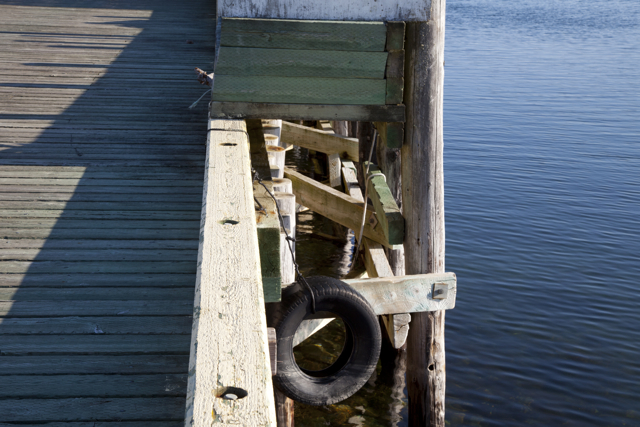
Pictures were taken on the West Quoddy dock. 
Nets and buoys are for fishing herring.  Commercial vessels and pleasure craft in Canada longer than 12 meters are required to carry two or more fire buckets.

Tuesday, April 9, 2013

Suddenly Sparrows: A Report on Certain Signs Lately Observed in West Quoddy


9 April 2013

Suddenly sparrows and
constant singing.
They begin before sunrise.


Cluster of ducks at the point.
Geese root in dead grasses,
and the pheasants are silly.


Yesterday lobster boats launched,
traps mount on the dock:
steep wakes slop against shore.


Muddy boots and scent of earth,
rushing clatter of ditchwater,
still no frogs.       


Notes

Pictures were taken on the Eastern Shore of Nova Scotia near Gammon's Pond, in West Quoddy and in Marie Joseph.

Monday, April 8, 2013

Spring is the slowest season


8 April 2013

Nights I listen
for the peepers. They have
not wakened yet.


But sparrows sing and
robins peck at hardened earth
rime of ice on stone.


Cold wind, colder sea:
spring is the slowest season.
Thick clouds disgorge rain.    


Notes
Photographs were taken at Taylors Head Park, on Psyche Beach. They are part of a series I am calling "Landweaves"--found knittings of various sorts.  For more images of this sort, see http://pinterest.com/karincope/landweaves/  

Sunday, April 7, 2013

West Quoddy Harbour Auhtority User Fees

7 April 2013


Notes

This is an experiment in visual poetry, in which the images must speak for themselves.

Pictures were taken this morning at the West Quoddy "Harbour Auhtority" dock.  I was trying out a technique of vertical image stacking I encountered in the photography of David Hilliard (see http://www.davidhilliard.com/). Such vertical stacking, he says, "tears a space open;" by making your focus discontinuous, it mixes memory and observation. It seemed a format particularly suited to the infinite vertical scroll of a blog.