Showing posts with label poetry. Show all posts

Thursday, April 12, 2018

A Winter in the Baja


A sudden drift of

fish startles up from the sea,

their silver backs flash. 


Nightfall. The Little

Dipper pours starlight over

darkened mountain tops.


Walking a desert

track we turn and stumble on

piles of pipefish bones.


Break a branch of the

torote tree—sharp scent of

bitter orange lingers.


Palo Adan, grey

branch, half-moon: one scarlet bud

streaks the evening sky.


A Pacific wind

freshens. Hungry clouds nibble

The fattening moon.


Empty shells of a

conch graveyard glisten: so much

broken crockery.


Almost spring but the

sharp scent of beach fires burning

intimates autumn.


Walking on the beach

we startle a cricket; it

leaps into the sea.


A buzzard sits on

an abandoned power pole,

lines cut and dangling.


A beached sea lion

skull slowly submerges: sand

fills the eye sockets.


-->

First published in January 2018 in "Fresh Voices," an online publication of the Canadian League of Poets:
http://poets.ca/2018/01/19/fresh-voices-karin-cope-nan-williamson-barbara-black/

All photos were taken during the course of shore walks while sailing in the Sea of Cortez in 2016, 2017 and 2018.

Friday, October 20, 2017

Poem trying to get in out of the rain


Autumn rattles at the windows of the night, rips
leaves from looping trees, punches
gustily against the wall.
I waken to creaking roofbeams, peer
sightless into blacklit night. Nothing
to see, but everything that is is sounding:
such a rush and crash of waves on rocks;
the clothesline sings a one-note samba,
the chimney turns to didgeridoo.
Only the dog sleeps, silent, beside me.
If I open the door to let the poem in,
it can sleep all night on the bench by the fire and
I'll return to bed then to wake you, slipping
frigid feet behind your knees.


Photos are of Usnea, or "Old man's beard" lichens in British Columbia and Nova Scotia.

Thursday, November 10, 2016

The wheels of the overturned wreck still spinning


(On negative capability)

The wheels of the overturned wreck
still spinning--

I am having trouble seeing how--
some lines trip, now they blare

my head my eye
an old tv, giving up the ghost.

Before horror,  everything.
Beyond horror, nothing.

O scow or barge loose--
should safely be moored. But people, those
people who have power in them?

I don't mean to despair, I mean if we do not--
at least to hear
in the manner of poetry.

Working notes

The second and third stanzas of this poem are taken from a journal entry trying to account for my experience of these last two days, as the reality of a Trump presidency in the US begins to sink in; the rest are citations and modifications of some writings of American poet George Oppen, who fled, with his wife and daughter to Mexico during the early 1950s after being repeatedly harassed by the FBI for his radical politics. Oppen is celebrated as a poet of "negative capability"--Keats' term for a poet who builds work from the capacity to ask questions and to reside in "uncertainty, mystery and doubt," rather than foreclosure or a drive to a preconceived end. For Oppen, and perhaps for all of us, ethics emerges from such confrontations with what seem to us to be situations of crisis.  How do we describe and respond fulsomely to our histories, and to the events that unfold around, before, because of and despite us? Such activities take time, and often, in a crisis, that's exactly what we're sure we do not have. Nevertheless, to take the time to try to think, to hear and to see, in and despite our various states of blindness, deafness and panic, is our truest calling, and something like prayer.

Those lines that begin "the wheels of the overturned wreck..." are taken from Oppen's poem "Route," which recounts his experience, in 1925, of being responsible for a fatal crash. Drunk, and at the wheel, he lost control of his vehicle. I don't mean to despair, I mean if we do not--" also reworks a portion of that poem, which is found in New Collected Poems (2002). (I write: "I don't mean to despair, I mean if we do not--/at least to hear/ in the manner of poetry;" Oppen wrote: "I don't mean he despairs, I mean if he does not/ He sees in the manner of poetry.")

"Before horror..." and "O scow or barge loose..." are lifted from Oppen's "Daybook 1," working notes that seem to have been written between 1963 and 1964, after the Oppens had returned to the US. (Stephen Cope, ed., George Open: Selected Prose, Daybooks, and Papers.) Berkeley: University of California Press, 2007): 58. In this section, Oppen muses on the latent potential of those who approach situations as bystanders, rather than actors.

Tuesday, May 3, 2016

Rereading or Practicing Surrealism? Method: short poems from novels. First trial: Andre Breton


If you block out most of the words on the famous first page of Breton's Nadja, you get a question transposed into a statement:

"I am who(m) I haunt."

All of Nadja could be summed up in this phrase, Breton's ode to himself, or to the power to drive an ill woman mad. --At least, that's one possible reading of the story.

One is not inclined to imagine that such a reading is incorrect when face to face with the last image in the book, or rather, its revision:


In the caption to this self-portrait, Breton writes as one who envies himself--and in this way becomes, at once, himself and himself-as-someone else, Nadja, a man of record, a public figure, a writer.

No wonder it also always feels like a trick. "I must admit this last word is misleading." And so, too, those that precede it.

The Fine Print 

I should explain what has occasioned this short excursus on Breton, yet another one, for I've written about him--and Nadja--here before, although arguably stopped just short of the insight that the exercise of literally blocking out bits of his text finally offered me--that when Breton writes, he writes for and of himself; he haunts himself; every other is just a foil. You can judge for yourself: see http://visiblepoetry.blogspot.ca/2012/03/something-wrong-notes-on-bretons-nadja.html

This time, which is to say, yesterday, I was thinking about a course that I will teach again in the fall, something I've called Strategic Fictions.  The course is designed to expose visual artists who want to make use of fiction in their work to the techniques of fiction as writers think about them, as well as to a number of contemporary artists and artworks (sometimes called "Superfictions") that make use of various aspects of fiction: for example, Sophie Calle, Joan Fontcuberta, Iris Haeussler, Janet Cardiff and George Bures Miller, Emily Vey Duke and Cooper Battersby, The Museum of Jurassic Technology, and so on. 

I have previously, with many misgivings, made use of Nadja as precursor text in this course, as a way of visibly linking the strategies of the artists we consider back to various modernist exercises, including (auto)biography-as-illustrated-novel (Calle, Haeussler, Fontcuberta, Cardiff and Miller and Duke and Battersby all enact variations on this theme). In fact, my previous piece on Breton and Nadja, "'Something Wrong': Women Who Crash," began as an effort to engage the image-using and citational strategies of Nadja to new ends, and was first drafted as a lecture for the Strategic Fictions class.  

Yesterday, however, I was wondering if I could engage my students in a more direct project of handling Breton's text.  I'd been looking at and thinking about poet Mary Ruefle's "erasure" books--works where she takes an earlier text and blocks out sections of it to make a new text.  See for example, a page from the poem/book, A Little White Shadow, itself constructed from a novella published by Emily Malbone Morgan in 1889 also entitled A Little White Shadow:


Such works-by-erasure are common in poetry, especially contemporary poetry, and repeatedly and knowingly give the lie to various claims to "originality." Poets are constantly writing in the style of, or "after" various others by borrowing from and reworking earlier poetry, often tongue-in-cheek, or building poems from excision, concision and mistranslation.  A cento is, for example, a poem entirely composed from fragments found elsewhere, heretical verse, taking one sort of text and making it say something else. This form, named and exercised by Roman poets of the second or third century, is all about the generative power of mistakes or, more particularly, the capacity of heretics to re-author the Gospels simply by citing select bits of them.  The Latin word harks back to the Greek verb kentron, "to plant slips of trees," as well as, or so the dictionary and various commentators claim, to a later Greek formation, kentrone, or "patchwork garment."  We are all born from someone and somewhere else; little or nothing is new. 

Likewise, Canadian poet Gregory Betts has made much of what he calls "plunderverse"; as with Ruefle's work, he takes a source text and, preserving the order of the words and letters, strikes out until the old text speaks differently, anew.  "We are born into language but a language not our own," Betts writes.  "We can only speak a language not our own." (See Betts' Plunderverse Manifesto here: http://www.ottawater.com/poetics/poetics05/05betts.html and a review of his aptly named The Others Raisd in Me, a work of plunderverse here: http://aarontucker.ca/reviews/the-others-raisd-in-me-a-plunderverse-project-gregory-betts/).   

Similarly, artist Tom Phillips makes use of such dadaist-become-surrealist technique in his 1987 A Humument: A Treated Victorian Novel, one page of which is reproduced here:


Such contemporary poetic or painterly projects are, for the most part, descendants of techniques like those spelled out in Tristan Tzara's 1920 "Dada Manifesto on Feeble and Bitter Love," where he instructs readers to cut words from the newspaper, put them in a bag, shake, and pull them out, one by one, writing them down in the order in which they appear. The resulting "poem will resemble you," Tzara promises.  Still another example may be found in the recyclings of Max Ernst's "collage-novels" of the 1930s, for example La femme 100 tetes or Une semaine de bonte, where Ernst combines drawings on Victorian illustrations into long wordless and surreal tales--as in this weird and textured plate from Une semaine de bonte/ A week of kindness:


 With such examples on my mind then, and wondering about possible exercises I might assign to students grappling with Nadja for the first time (or, as also happens, falling in or out of love with it--what is it about the power of the surrealists to command us with their mad loves and hates?), I opened my copy of Nadja, trans., Richard Howard  ***with this phrase, "trans. Richard Howard," I have been echoing or writing "after" Frank O'Hara's wonderful and breathless poem "The Day Lady Died"*** and began mentally blocking out text, rewriting the first page, and thereby writing a short poem from a novel--if this little exercise can be called a poem. Or perhaps all of these words and every one of these citations is the poem, which can only invite further plunder.

But wait; there is more.

One final note. As I am finishing this text, I open my copy of Breton's L'Amour fou, a(nother) book in his trilogy of novels dedicated to the unfolding of unexpected encounters and coincidences. A ticket falls out on which is printed the following command: "Please read carefully." I do. Or rather, I read that line several times, since I don't have my reading glasses with me, and what follows it is printed in type so painfully small that it devolves into wavering black squiggles, a drawing perhaps, another block of excised text. Definitely not words.  

Everything repeats itself; nothing is new; what is the difference between altering and misreading, and simply not reading? This is not a minor question in an era when Donald Trump is touted as a viable US presidential candidate.

Oddly enough, I have been reading this morning the text of lecture by Mary Ruefle entitled "Someone Reading a Book is a Sign of Order in the World." There she recounts one day when she was in her forties, "an ordinary day, neither sunny nor overcast," when she could no longer read; the words would simply no longer compose themselves in any sort of sensible order. Ruefle writes:

[T]he words that existed so I might read them sailed away, and I was stranded on a quay while everything I loved was leaving. And then it was I who was leaving: a terror seized me and took me so high up in its talons that I was looking helplessly down on a tiny, unrecognizable city, a city I had loved and lived in but would never see again."

She explains that really, she needed reading glasses, but "before I knew that, I was far far away." The train had left the station. Everything was fraudulent; the landscape had shifted; her sense of reading as some sort of orderly practice in the world had come completely undone. 

But in fact, although we usually don't recognize it, this is where we are when we are reading--on edge, overtaken, helplessly hopelessly behind. We've missed the train; we're on the wrong train, or simply find that where we thought we were is elsewhere. Or nowhere. There is no there there (says Gertrude Stein in the 1930s as she is touring the United States).

Please read carefully. 
We do. And we cannot.
Ever.

And so we begin again.

We sit and we read and then we set out...reaching town as evening [begins] to fall.*

*These are last words of the English translation of W.G. Sebald's Austerlitz, a book about reading, lost memory, extirpation, transportation and death

Reading. Writing.
We think these activities will save us, but really they carry us ever closer to death--even as they put off--still another hour!-- the arrival of that day. 

Maybe this piece should have been called "Someone reading a book is a sign of disorder in the world."

Monday, January 18, 2016

Spadework: On Poetry, Empire and the Commons


I have been reading, back to back, Richard Flanagan's marvelous novel, The Narrow Road to the Deep North, and Stephen Collis's book of incantatory poems, The Commons.  In his now quite famous essay, "Of Blackberries and the Poetic Commons," Collis argues that
Poetry and blackberries are homologous in their relation to capital--marginal, fringe, ignored by investment, sprouting in the gaps profitability and privatization leave everywhere...Because capital does not accumulate around poetry, it is allowed to exist--as it always has--as a putative commons (135).
 This is an appealing argument, and in many ways it feels true.  Poetry is the language of the interstitial; it works the gaps between sense and nonsense, ordinary language and arcana, generating out of what looks like nothing pure surplus. 


And yet, perhaps this view of poetry is too alluring. Is it always so revolutionary?  Elsewhere in his essay, Collis speaks of the blackberry bush as "virtually the negative image of European colonization" (134).  Blackberries thus occupy "the junk spaces capital has used up or forgotten or left as underdeveloped pockets" (134), Collis writes; they are fruitful, and give their bounty from these "wastelands" for nothing.  Nevertheless the blackberry of which he writes, Rubus armeniacus,  more commonly known as the Himalayan Blackberry, is, as Collis acknowledges, also itself an interloper, a settler, an introduced fruit given to taking over "disturbed sites." First cultivated in North America in 1885 by Luther Burbank--a real seed entrepreneur, among other things developer of the Shasta daisy and the Burbank Russet, the most widely cultivated and consumed potato in the world--the Himalayan Blackberry has thoroughly colonized West Coast byways. What has this once Persian fruit replaced? Harvested trees? Salmonberries? Thimbleberries? Currants? Who can now remember?

We don't care about such details when it is hot and we are thirsty and the berries hang, delicious and ripe, along the roads and trails where we walk. But we do care whether such public spaces will be gobbled up by the real estate boom on the West Coast--indeed, we sometimes find the paths to coastal rights of way by following where those blackberry bushes lead. But how many more years will we be able to sit on such scraps of beach, framed on  either side, as they always are, by multi-million dollar properties? Sooner or later, if the boom continues, these blackberries will be uprooted; this beach and then that one, along with the right of way, closed off and overshadowed. 


I seem to agree with Collis then, that blackberries are space-holders; as figures for the commons, they also stand in, at once, for past and future losses.  They are the surpluses, the marginal life forms that capital will ultimately overrun.  Collis writes,
The blackberry commons (as a social space and relation) is not so much a holdover from the past as it is a by-product of capital's speculative aims in the present and future. What shreds of commons we now have are more often than not gaps and lesions in capital's ever expanding body....breaches that will later be filled with investment, once devaluation has proceeded far enough to be profitable (135).
But--and this is the crucial question--does poetry work as blackberries do, opposing capital, but nevertheless also functioning as its forward and rear guards? Flanagan's tale suggests a weirder and less comfortable scenario.  In it, twentieth-century Anglo-American and Japanese empires are shown to be mirror figures; each reserves and exalts its poetic tradition (Catullus, Tennyson, Kipling; Basho, Issa, Shisui); each commits its wartime atrocities; each has its idea of glory, of perfection, of worthiness. Here, poetry is at once diversion and finest expression of national belonging; history; anthem; the body of the emperor, of right; and prelude to slaughter. Here, poetry is hope, death, and an idea of order so demanding that it does not admit of incompletion. How can this be?

Here our arguments converge.


Because it is worth nothing, poetry may also be exalted; it can be affiliated with absolute rule and absolute butchery, with nobility, hopefulness, handwashing and death--precisely because it is not aligned with capital.  In Flanagan's account then, poetry is exactly what is limned by empire, and not simply the wild force at its ragged edge that speaks other truths. And this too is true.

Flanagan takes as his epigraph a line from Celan's Wolfsbohne (Wolf's-bean) that gives the lie to Adorno's claim that after Auschwitz there can be no more poetry: "Mother, they write poems." We might say then that radical critique is a matter of blackberries--like us, as carelessly wandering blackberry pickers, it feasts on the succulence of the by-ways; meanwhile, poetry does its awful double-duty, playing at profligacy, at waste riches, at little nothings--and the very names of power or empire itself.

On either side then, for its memory can be very long, poetry reminds capital that it too will amount to nothing. Someday. 


his head cut off and all the vowels
and consonants taken out one by one
Stephen Collis, from "Clear as Clare," The Commons (33).


Uneasy ground / Afterthoughts

Having written these reflections on poetry, empire and the commons, I went to sleep. I dreamed that I had gone down into the basement to investigate a strange sound, and found an unfamiliar child there, an 8 or 9 year old boy.  Upon seeing me, he fled upstairs. I wondered what he was doing, and worried vaguely about my father, who in the dream was on an upper floor.  But when I turned around, the child was coming back downstairs, wielding a shovel.  I could see that he was going to swing it at my head. Panicked, I reached beside me for the fire rake, picked it up, put it down, lost it, searched again, all the while thinking no, I cannot do this: I cannot hit a child in the head.  I am going to have to take this beating, even if it kills me.  And then I remembered that I had a voice--would my father, who is quite deaf, hear me? --And if he did, what good would it do? He's also quite frail now, and crippled by arthritis. Still, with great effort, as the boy swung his shovel at my head, I cried out, waking both myself and the dog, who slept beside me.

Spadework. Poetry: if ever I thought it might help me or prove me innocent, I was wrong. Clarity (and not too much of that!),  not moral superiority, are all that one can hope for in its fields and laneways. A citizen of privilege in this most destructive and self-righteous of empires, I too do murderous harm, and will also die. Poetry may look as if it will ennoble me, but it cannot absolve me. And my father will neither hear me nor save me as we sit on both sides of this ditch, slaughterers and slaughtered:  
Mother, they write poems.
O
Mother, how much
most alien of ploughland bears your fruit.
Bears it and nourishes
those who kill!


 Notes

Images of wild grasses, thistles, raspberry canes, broken bulrushes and lichens ("weeds") were taken in December 2015 on our (thoroughly surveyed, partially fenced and containing a right of way to a launch slip) property in West Quoddy, Nova Scotia. If we are being truthful about such borders, we must also acknowledge that this property is located in Mi'kma'ki, the ancestral and unceded territory of the Mi'kmaq People. Although this territory is covered by the “Treaties of Peace and Friendship” which Mi’kmaq and Wolastoqiyik (Maliseet) peoples first signed with the British Crown in 1725, the treaties did not deal with surrender of lands and resources. Instead, these treaties recognized Mi’kmaq and Wolastoqiyik (Maliseet) title and established the rules for what was to be an ongoing relationship between nations, rules repeatedly and continually disrespected, breached and broached from then until now by settlers, as our putative legal title to this bit of land suggests.

All citations from Stephen Collis are from The Commons (Second Edition). Vancouver: Talonbooks, 2014.

Richard Flanagan's The Narrow Road to the Deep North shares its title with Basho's prose and verse travel journal from 1689, Oko no Hosomichi.  One of the best books I've read in a very long time, Flanagan's novel won the Man Booker Prize in 2014. In North America, it is published by Alfred K. Knopf.

I've cited Michael Hamburger's translation of Celan's 1959 draft of Wolfsbohne from Poems of Paul Celan (Revised and Expanded), New York: Persea Books, 2002, p. 345.


Spadework: On Poetry, Empire and the Commons


I have been reading, back to back, Richard Flanagan's marvelous novel, The Narrow Road to the Deep North, and Stephen Collis's book of incantatory poems, The Commons.  In his now quite famous essay, "Of Blackberries and the Poetic Commons," Collis argues that
Poetry and blackberries are homologous in their relation to capital--marginal, fringe, ignored by investment, sprouting in the gaps profitability and privatization leave everywhere...Because capital does not accumulate around poetry, it is allowed to exist--as it always has--as a putative commons (135).
 This is an appealing argument, and in many ways it feels true.  Poetry is the language of the interstitial; it works the gaps between sense and nonsense, ordinary language and arcana, generating out of what looks like nothing pure surplus. 


And yet, perhaps this view of poetry is too alluring. Is it always so revolutionary?  Elsewhere in his essay, Collis speaks of the blackberry bush as "virtually the negative image of European colonization" (134).  Blackberries thus occupy "the junk spaces capital has used up or forgotten or left as underdeveloped pockets" (134), Collis writes; they are fruitful, and give their bounty from these "wastelands" for nothing.  Nevertheless the blackberry of which he writes, Rubus armeniacus,  more commonly known as the Himalayan Blackberry, is, as Collis acknowledges, also itself an interloper, a settler, an introduced fruit given to taking over "disturbed sites." First cultivated in North America in 1885 by Luther Burbank--a real seed entrepreneur, among other things developer of the Shasta daisy and the Burbank Russet, the most widely cultivated and consumed potato in the world--the Himalayan Blackberry has thoroughly colonized West Coast byways. What has this once Persian fruit replaced? Harvested trees? Salmonberries? Thimbleberries? Currants? Who can now remember?

We don't care about such details when it is hot and we are thirsty and the berries hang, delicious and ripe, along the roads and trails where we walk. But we do care whether such public spaces will be gobbled up by the real estate boom on the West Coast--indeed, we sometimes find the paths to coastal rights of way by following where those blackberry bushes lead. But how many more years will we be able to sit on such scraps of beach, framed on  either side, as they always are, by multi-million dollar properties? Sooner or later, if the boom continues, these blackberries will be uprooted; this beach and then that one, along with the right of way, closed off and overshadowed. 


I seem to agree with Collis then, that blackberries are space-holders; as figures for the commons, they also stand in, at once, for past and future losses.  They are the surpluses, the marginal life forms that capital will ultimately overrun.  Collis writes,
The blackberry commons (as a social space and relation) is not so much a holdover from the past as it is a by-product of capital's speculative aims in the present and future. What shreds of commons we now have are more often than not gaps and lesions in capital's ever expanding body....breaches that will later be filled with investment, once devaluation has proceeded far enough to be profitable (135).
But--and this is the crucial question--does poetry work as blackberries do, opposing capital, but nevertheless also functioning as its forward and rear guards? Flanagan's tale suggests a weirder and less comfortable scenario.  In it, twentieth-century Anglo-American and Japanese empires are shown to be mirror figures; each reserves and exalts its poetic tradition (Catullus, Tennyson, Kipling; Basho, Issa, Shisui); each commits its wartime atrocities; each has its idea of glory, of perfection, of worthiness. Here, poetry is at once diversion and finest expression of national belonging; history; anthem; the body of the emperor, of right; and prelude to slaughter. Here, poetry is hope, death, and an idea of order so demanding that it does not admit of incompletion. How can this be?

Here our arguments converge.


Because it is worth nothing, poetry may also be exalted; it can be affiliated with absolute rule and absolute butchery, with nobility, hopefulness, handwashing and death--precisely because it is not aligned with capital.  In Flanagan's account then, poetry is exactly what is limned by empire, and not simply the wild force at its ragged edge that speaks other truths. And this too is true.

Flanagan takes as his epigraph a line from Celan's Wolfsbohne (Wolf's-bean) that gives the lie to Adorno's claim that after Auschwitz there can be no more poetry: "Mother, they write poems." We might say then that radical critique is a matter of blackberries--like us, as carelessly wandering blackberry pickers, it feasts on the succulence of the by-ways; meanwhile, poetry does its awful double-duty, playing at profligacy, at waste riches, at little nothings--and the very names of power or empire itself.

On either side then, for its memory can be very long, poetry reminds capital that it too will amount to nothing. Someday. 


his head cut off and all the vowels
and consonants taken out one by one
Stephen Collis, from "Clear as Clare," The Commons (33).


Uneasy ground / Afterthoughts

Having written these reflections on poetry, empire and the commons, I went to sleep. I dreamed that I had gone down into the basement to investigate a strange sound, and found an unfamiliar child there, an 8 or 9 year old boy.  Upon seeing me, he fled upstairs. I wondered what he was doing, and worried vaguely about my father, who in the dream was on an upper floor.  But when I turned around, the child was coming back downstairs, wielding a shovel.  I could see that he was going to swing it at my head. Panicked, I reached beside me for the fire rake, picked it up, put it down, lost it, searched again, all the while thinking no, I cannot do this: I cannot hit a child in the head.  I am going to have to take this beating, even if it kills me.  And then I remembered that I had a voice--would my father, who is quite deaf, hear me? --And if he did, what good would it do? He's also quite frail now, and crippled by arthritis. Still, with great effort, as the boy swung his shovel at my head, I cried out, waking both myself and the dog, who slept beside me.


Spadework. Poetry: if ever I thought it might help me or prove me innocent, I was wrong. Clarity (and not too much of that!),  not moral superiority, are all that one can hope for in its fields and laneways. A citizen of privilege in this most destructive and self-righteous of empires, I too do murderous harm, and will also die. Poetry may look as if it will ennoble me, but it cannot absolve me. And my father will neither hear me nor save me as we sit on both sides of this ditch, slaughterers and slaughtered:  
Mother, they write poems.
O
Mother, how much
most alien of ploughland bears your fruit.
Bears it and nourishes
those who kill!


 Notes

Images of wild grasses, thistles, raspberry canes, broken bulrushes and lichens ("weeds") were taken in December 2015 on our (thoroughly surveyed, partially fenced and containing a right of way to a launch slip) property in West Quoddy, Nova Scotia. If we are being truthful about such borders, we must also acknowledge that this property is located in Mi'kma'ki, the ancestral and unceded territory of the Mi'kmaq People. Although this territory is covered by the “Treaties of Peace and Friendship” which Mi’kmaq and Wolastoqiyik (Maliseet) peoples first signed with the British Crown in 1725, the treaties did not deal with surrender of lands and resources. Instead, these treaties recognized Mi’kmaq and Wolastoqiyik (Maliseet) title and established the rules for what was to be an ongoing relationship between nations, rules repeatedly and continually disrespected, breached and broached from then until now by settlers, as our putative legal title to this bit of land suggests.

All citations from Stephen Collis are from The Commons (Second Edition). Vancouver: Talonbooks, 2014.

Richard Flanagan's The Narrow Road to the Deep North shares its title with Basho's prose and verse travel journal from 1689, Oko no Hosomichi.  One of the best books I've read in a very long time, Flanagan's novel won the Man Booker Prize in 2014. In North America, it is published by Alfred K. Knopf.

I've cited Michael Hamburger's translation of Celan's 1959 draft of Wolfsbohne from Poems of Paul Celan (Revised and Expanded), New York: Persea Books, 2002, p. 345.


Monday, October 26, 2015

What the dog's nose knows, or the art of noticing with the dog (art walk challenge #1)

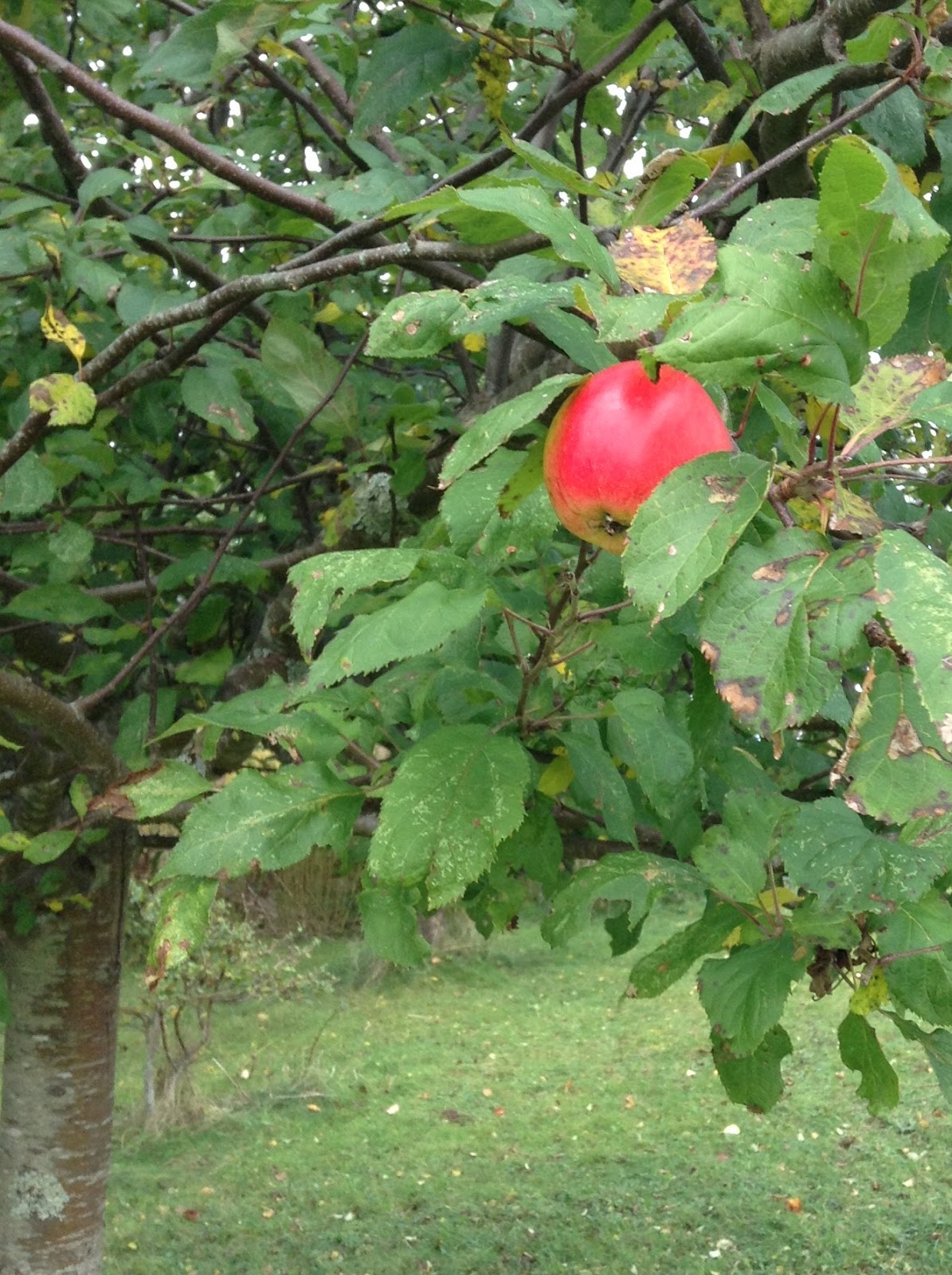
A ripening apple

Just as birds need to fly and deer need to run, we need to walk....to be happy.
Enrique Peñalosa, Mayor of Bogotá

Every place structures our perceptions; so too, does every sort of being. We all know this, and yet we rarely attend fully enough, in our daily lives, to the implications of such insights.  While we might be quick to agree that what one notices while walking on a city street is dramatically different than what one hears or smells while out in the woods--the roar of traffic drowns out the subtle scrape of drying leaf against leaf in the breeze, or the lilt of birdsong--we're noticeably less willing to entertain other entities' or creatures' perceptual modes as a part of our own, unless we're trained observers of one sort or another. 

And yet everyone who lives with a dog walks such a path daily: the dog regularly notices things we do not, and bit by bit, our association with a dog tunes our apperceptions to theirs. We see, by dint of daily walking together, that here, by this tree, is a particularly exciting scent, while that patch of grass there is somewhat frightening. The dog's responses begin to frame our own, even when we don't quite understand what is going on. For example, a friend who lives in urban Vancouver recently reported taking her dog, a young Great Dane, for a walk in the predawn morning. All of a sudden the dog began growling.  My friend neither sensed nor saw the trouble, thought her dog had been somehow startled by a blowing leaf. And then the lights from a passing car illuminated a row of coyote eyes. Smart dog! writes my friend, relieved to have arrived back home safely. 

Enya sniffs for field mice

Often enough, what the dog senses is invisible to us, and thus appears somehow nonsensical, irrational, idiosyncratic. What might we see or understand, however, if we attempted to walk through the world guided not by our own imperatives, but by the dog's? And why stop there? Why not follow a deer path and learn to notice what a deer might?  What about following a line of current, or the trajectory of a falling leaf? How would we walk through or map the world differently? What would we hear or smell or see otherwise? What novelties would strike us? How would our inner sensory and kinesthetic maps alter? Would our experience of walking, itself change, and how?  

Leaving aside for now the great epistemological debates about what we might ever know of another being's ways of knowing (culture and learning suggest we can share something on this front,) and the challenge of tempering or overcoming our tendencies towards anthropocentrism, would or could a simple set of exercises--"art walks" say--begin to help us to attune ourselves to alternately lived (and thus possible) interactions in the worlds where we live?

Such questions led to what I am calling my "art walk challenge #1: while out for a walk, maybe with a dog, notice and document zones where two or more life forms enter into conflict, avoidance and/or collaboration."

we follow a deer path down to the water (pond)

I made and annotated my own walk on and around the grounds where I live, in rural coastal Nova Scotia, and then invited others living elsewhere to do likewise. I offer a selection of notes from my walk, and others' responses below.  As I read over the responses I've collected, I'm struck by how like poetry they are--perhaps because poetry too is an art of aerial or subterranean attunement, a mode in or by which one hears or notices things that pass above and below the threshold of ordinary experience. Does this mean that poetry, too, is an art of listening with the dog? (Or sometimes, perhaps, with the deer?)

orchard where the deer (dog and crows) graze

My notes from Art Walk Challenge #1 (24 October 2015) are as follows: "Here, the deer avail themselves of apples from our trees and walk on paths that we've made. But we also follow deer trails to the pond (human made) and through the woods.  The dog follows other deer paths, munches on crab legs dropped by gulls, digs in mouse holes, chases grouse. We come across a rat's nest a neighbour has tossed from a barn. Dog drinks from ditches and at the edge of the bog."

Enya crunches up the remains of a crab where a gull dropped the carcass on the rocks in order to break it open

 
pond edge where one deer path ends


found on a neighbour's land: tossed out rat's nest

 
Video clip: Enya chases a spruce grouse

Friends responded as follows: 
Devon Query (Eastern Shore, Nova Scotia) writes, "Out with the dogs down to our shoreline. A feather, no two(!) are consumed immediately.....small ones, gull feathers.....then a crab part by the other dog. Finally the piece de resistance! A large gray gull feather.....NOT to be consumed here....but ferried back to the house for the morning's amusement!
Thanks gulls!"

Carol Bruneau (Halifax, Nova Scotia) sends along a picture, which she captions,
'Here's my deerstalker scenting prey in the urban wilderness:"
 

Faizal Deen (Ottawa, but remembering South Korea) is prompted by the video of Enya chasing a spruce grouse to write "Beautiful and free. Sabrina would go after the quails on Namsan when we lived in Seoul. It always made me nervous because had she caught one, we would've been fined and she could've even been taken away from me and euthanized. So, we always went to the mountain under the deep cover of night and she would run her heart out and chase all manner of beasts."

I note that Faizal's remembered walk documents not simply encounters or collaborations (don't the quail sometimes draw the dog on, and work to decoy it from a nest or another sensitive area?) but potential conflicts between his dog and quail (finding, flushing out and possibly killing birds in the dark), and potential conflicts between doggish pleasures and the law, which is to say, between the law and the dog's human companion (punishable by removal and death of the dog.)

Who knew that a simple walk could uncover so much? And doesn't it always, if we've attuned ourselves to notice? 

Of course, the sort of "tuning" I'm describing here, and asking my friends and readers to consider practicing, is not always so romantic.  It is also a deep part of our social and historical experience, now muted by urban habits, the comforts of modern shelters and our typical patterns of consumption. A good hunter or a nomad for example, (whether human or non human) regularly must perceive as another does in order to survive. But then, so do children, any creature that is lost, or any person or creature who lives without adequate shelter or food. Nervy and alarmed, we learn to read others' patterns and pathways, and to map out escape routes and diversions, as well as others' garbage dumps.  

From where I sit, in rural Nova Scotia, I cannot truly walk the routes taken by Syrian refugees as they flee the shifting and hostile landscapes of war and asylum. But I can begin to imagine these routes, in all of their heart-thumping horror and impossible hope--and indeed I must, and by so imagining be driven to act, if I am going to maintain that social awareness does any good good at all.

Looking towards the back of the pond where sea ducks nest


Saturday, October 3, 2015

What we're doing to stay afloat--the book!!


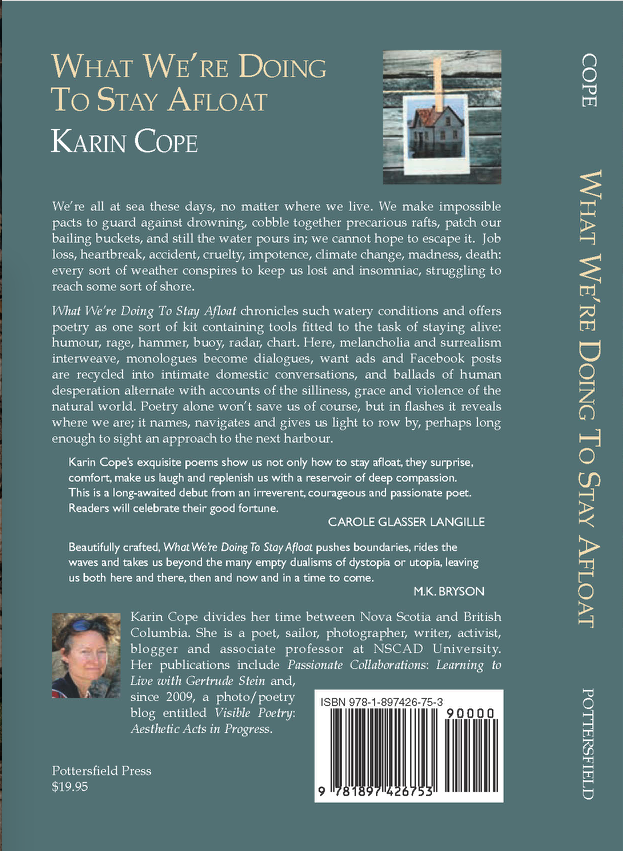
Yes, it is true, by the end of October 2015, What we're doing to stay afloat will be available in book form. 


The end of September and it was all done: the pages checked and double-checked and the cover proofed in emails and phone calls back and forth between publisher, designers, copy-editor and me. Ten days earlier the version I'd corrected vanished from the book designer's in-box; for some reason her email server would not accept messages from any of my accounts. We waded through the details on the phone and I sent my marked-up copy from my partner's email account. Success! One more version to proof, which we did, and then everything was sent off to the printer. Now we wait, and sometime towards the end of October there will be a book, a tangible object to touch and to hold, to open, to leaf through, to read.

Where can you get a copy? You can email me, leave me a message in the comments section of this blog or via facebook messenger, or order a copy directly from Indigo Books here  https://www.chapters.indigo.ca/en-ca/books/what-were-doing-to-stay/9781897426753-item.html
or Nimbus Publishing here http://www.nimbus.ca/What-Were-Doing-to-Stay-Afloat-P7335.aspx


Meanwhile, I'm also planning, building a website for, and soon will be installing my first solo video installation, entitled Flows (Given Water).  The show features video haikus of meltwater, looped projections of shifting inter-tidal zones, and enormous silent projections of moon jellies propelling themselves through deep green seawater. The weather turns rainy, and my dreams, too, are submerged in water greens and dim anxieties: is any of it good enough? Have I worked through my ideas fully enough? Will others see what I see, or wish to stop and muse in these spaces of drift and damp? I hope, and will know more in time.

https://givenwater.wordpress.com/

Water, water everywhere--and yes, at the show, I'll be offering water (locally sourced, of course,) to drink!