Anyone who knows much about loons, the birds, as opposed to lunes, the poetic form (more on that in a moment), knows that loons rarely flock; they tend to appear as loners. Still, we have sometimes seen them gather on the open water off of Quoddy, out among the islands, as the seals do. And in the summer now and then, we hear them playing call and response with the coyotes on the hill. The lune, on the other hand, a poetic form also known as "American Haiku," can be multiplied and assembled in what poet Craig Santos Perez calls "flocks of lunes." He stretches his out sideways, as if in flight; my lunes, on the other hand, float, as if isolated on the water, rather more like loons. Here, in Nova Scotia, it is said that the loons' cries predict a change in weather: rain, or the end of rain.
Typically, lunes come in two forms. One, invented by the poet Robert Kelly, consists of a 13 syllable verse, divided into three lines thus: 5 syllables/ 3 syllables/ 5 syllables. The other form, invented by poet Jack Collum, is composed of 13 words, divided similarly into three lines: 3 words/ 5 words/ 3 words. While lying awake two nights ago, and thinking about Craig Santos Perez's flocks of lunes, (which work on the Kelly syllable system), I began to compose the poem above in my head. Perhaps because it was the middle of the night, I scrambled the organization of the syllables, and composed instead according to a schema that runs 3 syllables/ 5 syllables/ 3 syllables. When I realized my error, I tried out a number of revisions, but in the end, preferred the simplicity and spareness that my stripped down version of the lune gave me. Who says mistakes aren't generative? And why can't we invent novel forms of lunes? What is poetry for, if not such small, but sublime, pleasures?
Image note: The photograph is of the view from my front windows, overlooking West Quoddy Bay.
Snow on ice the day after Christmas. We go for a walk and everything is quiet; just one car passes on the road. Our boots crunch against the cold snow; a spring burbles up out of the earth and rushes, ice free, beneath the trees. Silence: the snow has muffled the tinkling of the ice covered branches as the trees sway under their heavy loads. All day we are in twilight. And then night falls, and with it more snow.
Exercise: to see in the dark
Name some of the tongues that lick your ear
what the glass would see if it had eyes
where the flame leaps when it gutters
how the shadow lingers, draws a line
Note See what the glass would see if it had eyes is a poetic imperative, a mode of thinking posed by George Oppen, who was a 20th century American poet, anti-militarist, sailor and, for a time, a cabinet-maker and expatriate in Mexico, where, as a one-time member of the Communist Party, he'd fled from persecution from the House Committee on UnAmerican Activities. He returned to the US and poetry later in his life; he maintained that writing poetry was a particularly acute form of phenomenological investigation. A biography and links to some essays and poems may be found here: http://www.poetryfoundation.org/bio/george-oppen#poet
Let me be clear; it is she--Sophie Calle--who asks these questions. I simply answer, as truthfully as I can. (I'm sorry if you don't believe me. You should.)
--When did you last die?
--Late last night, three hours before the moon set. And then I woke again.
--What gets you out of bed in
the morning?
--In this season? The thought of getting back into it at night. And sometimes the promise of a hot eucalyptus scented bath. Coffee keeps me up, as does the endless list of tasks life has handed me. I cross one off, and it adds three. Or five, or ten. This is why I have to die every night; it is a way of resetting the clock. But, alas, the list survives.
--What became of your childhood dreams?
--They were all nightmares from which I am glad to have awakened.
--What sets you apart from
everyone else?
-- Nothing. I wear others' castoffs, and can hardly remember the last new pair of shoes. In any case, I will surely fit into another pair someone else has tossed aside.
--What is missing from your life?
--Nothing and then everything and then nothing again, so that I tumble into a quandry without top or bottom.
--Do you think that everyone can
be an artist?
--Of course. Everyone but myself, naturally. Which is why I must make such an effort to insist that I too might someday think of myself this way. Just not yet.
--Where do you come from?
--I grew up in a flat place south of this one, a thousand miles from the sea. The lights of the city blocked out the stars, and I thought that the endless roar of the traffic was the sound of the void.
I was, perhaps, right about that.
--Do you find your lot an enviable one?
--I have no truck with envy, though desire is everything. Can you desire a lot? Yes, I do.
--What have you given up?
--Lent. Small purchases. And often, hope.
--What do you do with your money?
--I put it into a household account and there it disappears. I am not sad about this; what else should I do with my money?
--What household task gives
you the most trouble?
--I loathe vacuuming, spot removal, scrubbing the bathtub and fixing other people's computers. And correcting grammar mistakes. Yet I seem to be an expert in all of these things.
--What are your favourite pleasures?
--You really think I'm going to tell you? Okay, I relent. One is....dancing. Nothing makes me happier. I wish I had been a choreographer. Or had known Pina Bausch.
--What would you like to
receive for your birthday?
--A complete set of poetry by CD Wright. And a really sturdy tripod. And perhaps a new pair of shoes all my own. Or a swimming pool; the sea is really too cold for sport these days.
--Cite three living artists whom you detest.
--Artists? I can't think of one. But politicians, managers, corporate kleptocrats? May an infinity of evil befall the lot of them, they who are the evil that shatters us. You want me to name them? Ayy, where do I begin? Just pick up the newspaper and check off the names on the front page.
--What do
you stick up for?
--Virtually everyone else.
--What are you capable of refusing?
-- Butter. Sugar. Cream. A ride. I wish I were capable of refusing stupidity, but sometimes I tumble into it and cannot get out.
--What is the most fragile
part of your body?
--My feet. Or perhaps my breath. This is why I didn't become a dancer, although I still long for such precise athleticism. Words rarely fail me, but my body lumbers; it is less reliable than it used to be.
--What has love made you capable of doing?
--Love has made me capable of hatred. Of rage, of going to battle. Strange perhaps, because the opposite is not true--rage and hatred don't make you capable of love.
--What do other
people reproach you for?
--Unfinished projects. Belatedness. Abstraction. Absence. Falling down when I should be standing up. Loving the wrong things. And they are right. I reproach myself for these failings too, among many others.
--What does art do for you?
--It is sometimes the only door to hope. Without it, I don't think much of human beings.
--Write your epitaph.
--Wait, that's not a question. I would prefer not to. Not yet, though as I've said, I do sometimes die every night. See? Another unfinished project. A belated requiem. Let us sing.
--In what
form would you like to return?
--As a winged thing, fleet of foot; nimble, pirouetting, light of heart, ripe and tender like a peach in July.
25 February 2010
San Juanico, Baja California Sur, Mexico
Northerlies, northerlies, northerlies. Fierce winds blow every day, all day. We sit on the boat and ride up and down, watching, watching. Will our anchor hold? Will the 17 other boats here also hold fast? Yes, and yes, to everyone's relief.
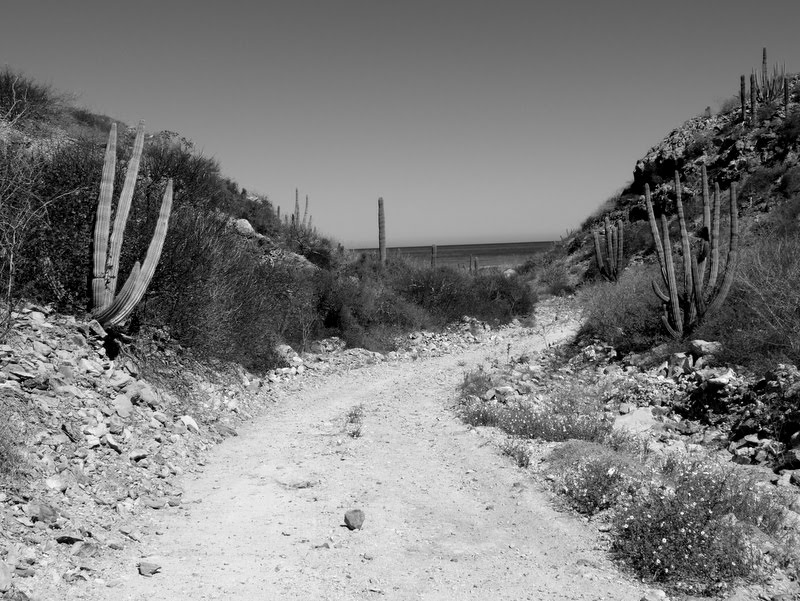
Today the wind died down a bit and we went ashore. We hauled the dinghy way up the beach and went for a long walk up dry creek beds and down dusty roads....Saw wild fossils, volcanic rock, all kinds of cacti living and dead, the desert in flower, birds of every sort, tracks of horse and cattle, even the dried skull of a cow of some sort, rotten hide tossed beside it, by a brackish waterhole. I took pictures of everything, all in black and white so they have the flavour of an old Mexican movie from the 50s.
In fact, I got so busy taking those pictures (especially of the skull) that Marike got really far ahead of me and I lost her! And the trail. It led beside the brackish waterhole to the beach, and then along a ridge. But I was far enough behind that all I was really following was Marike's hat. I thought.
Turns out when I got to the beach--certain that she was WAY down the beach ahead of me talking to someone--that the hat-wearer wasn't her at all, but another sailor in a wide-brimmed floppy hat. And a beard.
It was hot, the sun high, I couldn't find the trail, and I was thirsty. Marike had the gatorade.
I started to get worried. I looked way up on the ridge, along the road there, where I expected to see her, a dusty figure trudging uphill, white shorts flashing in the light. Nada.
I used the camera to zoom in on spots at one end of the beach or another. Yes, a flash of white, a flutter. She's waving to me!
Oops, no. Pelicans, not Marike.
Where was she? How could she have disappeared? How could I have lost her? What if she were on the trail somewhere and met up with a rattler or tripped and fell? What if that happened to me while I was looking for her? Or what if I got lost? What if........?
Finally, I regained my reason and began to look for signs of the trail BEFORE the beach, between the brackish water and the last line of hills. The beach, I reasoned, was what had distracted me; I'd been too seduced by the sea and that floppy hat, so that I missed both trail and girl.
Yes, there it was! And there were her tracks. I followed them along, through a fence, and soon there she was, coming back from the top of the hill. Turns out she'd seen me on the beach. Or, thought she'd seen me, but it was a mer-lady built of driftwood. Then she did see me--I was looking right at her, she said--and she motioned for me to come. But I never saw that.
Still, when we finally did meet up (I stowed my worry immediately, feeling silly, feeling embarrassed) that yicchy green gatorade she was carrying was pretty delicious....
What if we thought of poetry as something visible everywhere? Much of what we call poetry IS blogging, a lyric voice meandering through the sounds and images and movements of the world, trying on sensations and seeking interlocutors. Visible Poetry: Aesthetic Acts in Progress aims at expanding some horizons of this oldest of forms.
Brazen Spring
-
Brazen SpringA version of Random Breezes 3 —Du Fu, 712-770 CE(for Mike
Leon) The plum and cherry trees theredidn’t grow from windblown stones.I
planted the...
Six poems from Sue Goyette
-
We feature a folio and a conversation with the Halifax poet. Originally
published December 12, 2017. I’m reposting now in anticipation of a new
review of F...
To Alaska and Back I: Getting underway
-
It was wonderful to be back in the "land of the big trees;" each evening,
after our chores, we walked around the docks or wandered the neighbourhood.
One n...
Lexicon -- An Exhibition of Weavings by Bhakti Ziek
-
I have a new exhibition up at BigTown Gallery in Rochester, VT from October
26 - November 26, 2016. It is called *Lexicon* and includes new weavings as
wel...
.jpg)






 Posts
Posts


