Wednesday, April 10, 2013

Why is poetry an emergency?


10 April 2013

prose is a house
poetry a man in flames running quite fast through it

Anne Carson, Red Doc>

Why is poetry an emergency?
Why are some poems impossibly slow?


Imagine you are looking out to sea.
Every day for a year.


Some days the water rages. Other days
it chatters. Scatters. Freezes. Whispers.


Rarely is it silent. One vast silver mirror
dumping back a blanked-out sky.


Try a morning when the dog barks you up:
hungry geese are on the lawn.

  
Unmoored ice shards and founders, 
every grassblade dead and yellow.


How long must we
wait for the season to shift?


Slow spring, the kid 
at the filling station says. While gas guzzles 


snow gathers on the windscreen. 
You speed off, late for dinner.


Why is poetry an emergency?
Our hearts knock 


against a stubborn world. Inside,  
forever, the house is on fire.  


Notes
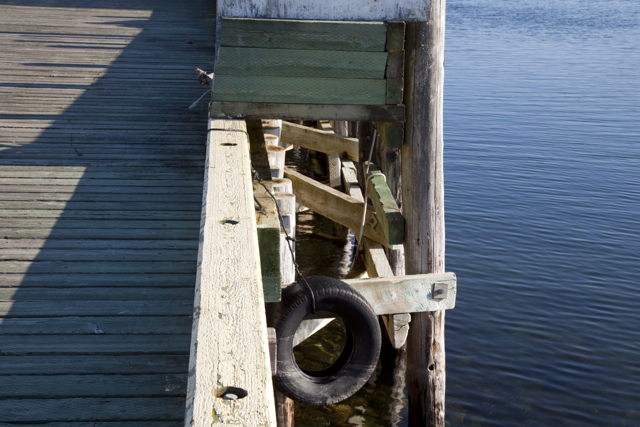
Pictures were taken on the West Quoddy dock. 
Nets and buoys are for fishing herring.  Commercial vessels and pleasure craft in Canada longer than 12 meters are required to carry two or more fire buckets.

Tuesday, April 9, 2013

Suddenly Sparrows: A Report on Certain Signs Lately Observed in West Quoddy


9 April 2013

Suddenly sparrows and
constant singing.
They begin before sunrise.


Cluster of ducks at the point.
Geese root in dead grasses,
and the pheasants are silly.


Yesterday lobster boats launched,
traps mount on the dock:
steep wakes slop against shore.


Muddy boots and scent of earth,
rushing clatter of ditchwater,
still no frogs.       


Notes

Pictures were taken on the Eastern Shore of Nova Scotia near Gammon's Pond, in West Quoddy and in Marie Joseph.

Monday, April 8, 2013

Spring is the slowest season


8 April 2013

Nights I listen
for the peepers. They have
not wakened yet.


But sparrows sing and
robins peck at hardened earth: 
rime of ice on stone.


Cold wind, colder sea:
spring is the slowest season.
Thick clouds disgorge rain.    


Notes
Photographs were taken at Taylors Head Park, on Psyche Beach. They are part of a series I am calling "Landweaves"--found knittings of various sorts.  For more images of this sort, see http://pinterest.com/karincope/landweaves/  

Sunday, April 7, 2013

West Quoddy Harbour Auhtority User Fees

7 April 2013


Notes

This is an experiment in visual poetry, in which the images must speak for themselves.

Pictures were taken this morning at the West Quoddy "Harbour Auhtority" dock.  I was trying out a technique of vertical image stacking I encountered in the photography of David Hilliard (see http://www.davidhilliard.com/). Such vertical stacking, he says, "tears a space open;" by making your focus discontinuous, it mixes memory and observation. It seemed a format particularly suited to the infinite vertical scroll of a blog.  

Saturday, April 6, 2013

Milk


6 April 2013
 
Why is milk good?
        Gertrude Stein, “Say it with flowers”


First play
So much milk
rivers of milk
my milk runneth over
    you mean your cup

    yes, a cup of milk for your thoughts

Second play
spilt milk
milksop
milk and honey and tea
milky t
milquetoast

don't sour my milk now

Third play
Here comes the milkman!
    Milkman who?

    Milkman Dead.
    He is?
       
Oh mother, we’re out of
milk again.   

Fourth play
Born in a stroke of milk
    mother’s milk
    father’s milk
under the milkweed

    (too rough for fishing today)

Fifth play
Hurry hurry, the sick won't wait
bring your brolly &
milk of magnesia

But I prefer jelly
&

poems.


(Last Act)
I photographed this shelf of cobalt blue bottles last summer in Billy Proctor's Museum on Gilford Island, Echo Bay, BC.  For more on Echo Bay, Billy Proctor and his museum, see http://quoddysrun.wordpress.com/2013/03/24/the-sound-of-something-vanishing-billy-procter/

The idea for dividing a poem into discrete exchanges or actions, each of which you might call a play--rather than a stanza--is borrowed from Gertrude Stein's early experiments with writing plays, in which heavy formal titles divide snatches of overheard conversation and wordplay. See for example, her Geography and Plays, first published in 1922.

Milkman Dead is a character in Toni Morrison's novel Song of Solomon, the boy who won't be weaned, and who then flies away.

The lines "too rough for fishing today" and the idea of visiting the sick with jelly and poems are taken from Under Milk Wood, Dylan Thomas's 1953 poem/play about the events of a single spring day in  lives of the coastal villagers of Llareggub, Wales. The piece, which is written as poem, radio play ("a play for voices") and for stage performance,  is filled with dreams and ghosts, inward musings and overheard gossip; it is a more highly structured, evolved, and palatable form of the sorts of play/poems Stein wrote.


(Last last act)
Why is milk good?
Is it?

Friday, April 5, 2013

No Tire Basura/ Don't Toss Your Trash


5 April 2013

Northern cities make you think that
life, best lived, accords with rules.
When will we revolt?

Snapshot: Mexico. Along the roadside.
Miles of mesquite and smoky mountains and
periodic warnings:
No Tire Basura/ Don't
Toss Your Trash.

Piles of detritus mount against
the sign and

nowhere else.    


Notes
This poem is dedicated to my friend and student, Jakub Milcak; he knows why.
Photos were taken on the Halifax Commons, near the skatepark.  
   

Thursday, April 4, 2013

Blue Heron Haikus


4 April 2013

Blue wings flap slowly,
great bird shadows the marsh:
spring shyly hungers.

When, if yesterday,
the blue heron returned, will 
frogs begin to sing? 

Notes

I took this picture in BC, while walking on a beach near Montague Harbour, Galiano Island, so this bird isn't an east coast Great Blue Heron. Still, it will do for illustrative purposes.

Thanks are due Marike, who noticed the first returned heron yesterday as we were walking by the marsh. She remarked how quiet and shy the birds are in the spring: "Spring is the season for mating and shyness." We had been recalling and laughing at how noisy the herons can be, particularly in the fall, when they scold us with their awful voices--GRAAAA AACK!--for stepping out of the house. But they are silent in the spring as they coast over ponds and marshes, looking for peepers and other prey. Often, too, they turn their backs to us, as if, when they cannot see us, we cannot see them. We're waiting still, and listening, for the first sign of the frogs.