Thursday, December 31, 2015

One horizon always hides another


I am speaking to my parents on Christmas day. It is unseasonably warm across much of the continent; storms brew over southern coasts.  My father wants my mother to tell me a story.  My mother has had a bad cold; such heat makes everyone sick my father says. And so my mother begins.  At the farmer's market she met an elderly African American woman.  They chewed over the weather, as everyone does, and how many were ill.  The woman told her how her grandmother used to say that a green winter brings many more stones to the graveyard. We hold this line as if it were a stone; we run it in and out of our mouths; we keep it, not as solace, but sooth, a telling insight.

One horizon always hides another--this too is not my line, but Kim Thuy's, from Ru. I like it because it reminds me of another, the title and key insight of a Kenneth Koch poem: One Train May Hide Another, a title inspired by a sign at a railroad crossing. Wise words from a fellow Ohioan at the cusp of the new year, when rain obscures our sense of winter, and passing events hide the days to come, the approaching trains we cannot yet see.  In his poem Koch advises watching, stillness, patience--good to remember on those days in between, when it sometimes feels as if nothing is happening:

It can be important
To have waited at least a moment to see what was already there.


The full poem below. 

One Train May Hide Another

Kenneth Koch, 1925 - 2002

(sign at a railroad crossing in Kenya)
In a poem, one line may hide another line,
As at a crossing, one train may hide another train.
That is, if you are waiting to cross
The tracks, wait to do it for one moment at
Least after the first train is gone. And so when you read
Wait until you have read the next line--
Then it is safe to go on reading.
In a family one sister may conceal another,
So, when you are courting, it’s best to have them all in view
Otherwise in coming to find one you may love another.
One father or one brother may hide the man,
If you are a woman, whom you have been waiting to love.
So always standing in front of something the other
As words stand in front of objects, feelings, and ideas.
One wish may hide another. And one person’s reputation may hide
The reputation of another. One dog may conceal another
On a lawn, so if you escape the first one you’re not necessarily safe;
One lilac may hide another and then a lot of lilacs and on the Appia
     Antica one tomb
May hide a number of other tombs. In love, one reproach may hide another,
One small complaint may hide a great one.
One injustice may hide another--one colonial may hide another,
One blaring red uniform another, and another, a whole column. One bath
     may hide another bath
As when, after bathing, one walks out into the rain.
One idea may hide another: Life is simple
Hide Life is incredibly complex, as in the prose of Gertrude Stein
One sentence hides another and is another as well. And in the laboratory
One invention may hide another invention,
One evening may hide another, one shadow, a nest of shadows.
One dark red, or one blue, or one purple--this is a painting
By someone after Matisse. One waits at the tracks until they pass,
These hidden doubles or, sometimes, likenesses. One identical twin
May hide the other. And there may be even more in there! The obstetrician
Gazes at the Valley of the Var. We used to live there, my wife and I, but
One life hid another life. And now she is gone and I am here.
A vivacious mother hides a gawky daughter. The daughter hides
Her own vivacious daughter in turn. They are in
A railway station and the daughter is holding a bag
Bigger than her mother’s bag and successfully hides it.
In offering to pick up the daughter’s bag one finds oneself confronted by
     the mother’s
And has to carry that one, too. So one hitchhiker
May deliberately hide another and one cup of coffee
Another, too, until one is over-excited. One love may hide another love
     or the same love
As when “I love you” suddenly rings false and one discovers
The better love lingering behind, as when “I’m full of doubts”
Hides “I’m certain about something and it is that”
And one dream may hide another as is well known, always, too. In the
     Garden of Eden
Adam and Eve may hide the real Adam and Eve.
Jerusalem may hide another Jerusalem.
When you come to something, stop to let it pass
So you can see what else is there. At home, no matter where,
Internal tracks pose dangers, too: one memory
Certainly hides another, that being what memory is all about,
The eternal reverse succession of contemplated entities. Reading 
    A Sentimental Journey look around
When you have finished, for Tristram Shandy, to see
If it is standing there, it should be, stronger
And more profound and theretofore hidden as Santa Maria Maggiore
May be hidden by similar churches inside Rome. One sidewalk
May hide another, as when you’re asleep there, and
One song hide another song; a pounding upstairs
Hide the beating of drums. One friend may hide another, you sit at the
     foot of a tree
With one and when you get up to leave there is another
Whom you’d have preferred to talk to all along. One teacher,
One doctor, one ecstasy, one illness, one woman, one man
May hide another. Pause to let the first one pass.
You think, Now it is safe to cross and you are hit by the next one. It 
     can be important
To have waited at least a moment to see what was already there.


Saturday, December 19, 2015

Fallen peonies


Almost winter, and Elisabeth has cut the peonies and laid them to rest.

It is not yet 5 pm and already the light is falling, failing. Faint pinks score the clouds and then dissipate. The balustrade glows white against the looming dark. A skim of ice stills the surface of the pond all day, a brittle solid checking waves, while uphill, sheets flap right off the line in the wind.  The top has sheared right off the old lichen covered spruce that guards the edge of the drive, and white leaves lie scattered about the raspberry canes and all up and down the road. A stripping wind last night laid them all low. 

Late morning, ducks cackle at the back of the pond.  Marsh grasses are brown and flattened, the colour of the dog's back.  We walk out the road and into the wind, the coolness against our teeth bracing, the sea grey and rumpled under a ridged grey sky. Cotton topped grasses flair against the fruiting mosses, ditches and lowlands are damp with icy streams. Coyote scat litters the road; Enya races up lanes and down deer paths, but then hurries back again, nervy with scent and danger.

Monday, October 26, 2015

What the dog's nose knows, or the art of noticing with the dog (art walk challenge #1)

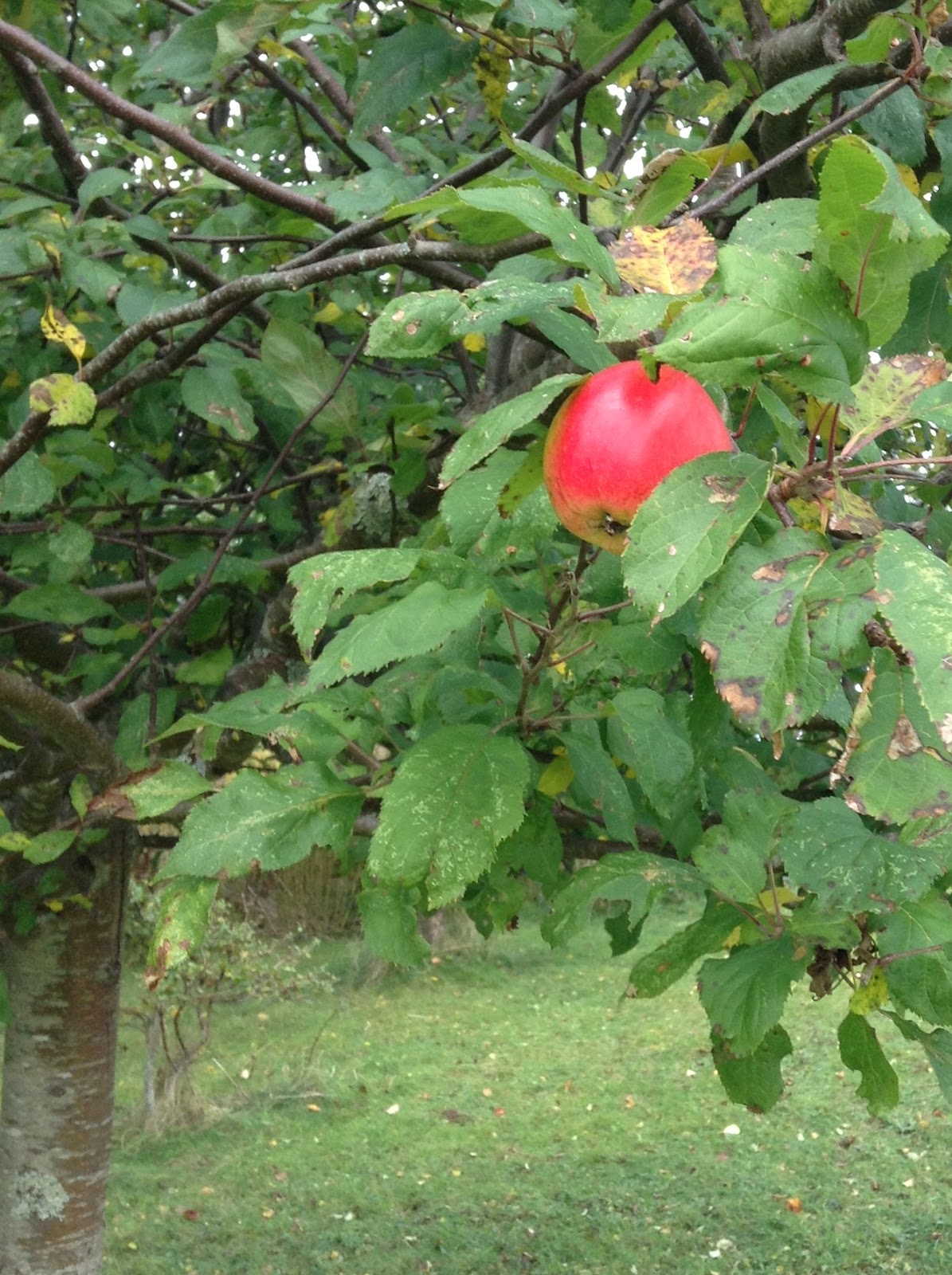
A ripening apple

Just as birds need to fly and deer need to run, we need to walk....to be happy.
Enrique Peñalosa, Mayor of Bogotá

Every place structures our perceptions; so too, does every sort of being. We all know this, and yet we rarely attend fully enough, in our daily lives, to the implications of such insights.  While we might be quick to agree that what one notices while walking on a city street is dramatically different than what one hears or smells while out in the woods--the roar of traffic drowns out the subtle scrape of drying leaf against leaf in the breeze, or the lilt of birdsong--we're noticeably less willing to entertain other entities' or creatures' perceptual modes as a part of our own, unless we're trained observers of one sort or another. 

And yet everyone who lives with a dog walks such a path daily: the dog regularly notices things we do not, and bit by bit, our association with a dog tunes our apperceptions to theirs. We see, by dint of daily walking together, that here, by this tree, is a particularly exciting scent, while that patch of grass there is somewhat frightening. The dog's responses begin to frame our own, even when we don't quite understand what is going on. For example, a friend who lives in urban Vancouver recently reported taking her dog, a young Great Dane, for a walk in the predawn morning. All of a sudden the dog began growling.  My friend neither sensed nor saw the trouble, thought her dog had been somehow startled by a blowing leaf. And then the lights from a passing car illuminated a row of coyote eyes. Smart dog! writes my friend, relieved to have arrived back home safely. 

Enya sniffs for field mice

Often enough, what the dog senses is invisible to us, and thus appears somehow nonsensical, irrational, idiosyncratic. What might we see or understand, however, if we attempted to walk through the world guided not by our own imperatives, but by the dog's? And why stop there? Why not follow a deer path and learn to notice what a deer might?  What about following a line of current, or the trajectory of a falling leaf? How would we walk through or map the world differently? What would we hear or smell or see otherwise? What novelties would strike us? How would our inner sensory and kinesthetic maps alter? Would our experience of walking, itself change, and how?  

Leaving aside for now the great epistemological debates about what we might ever know of another being's ways of knowing (culture and learning suggest we can share something on this front,) and the challenge of tempering or overcoming our tendencies towards anthropocentrism, would or could a simple set of exercises--"art walks" say--begin to help us to attune ourselves to alternately lived (and thus possible) interactions in the worlds where we live?

Such questions led to what I am calling my "art walk challenge #1: while out for a walk, maybe with a dog, notice and document zones where two or more life forms enter into conflict, avoidance and/or collaboration."

we follow a deer path down to the water (pond)

I made and annotated my own walk on and around the grounds where I live, in rural coastal Nova Scotia, and then invited others living elsewhere to do likewise. I offer a selection of notes from my walk, and others' responses below.  As I read over the responses I've collected, I'm struck by how like poetry they are--perhaps because poetry too is an art of aerial or subterranean attunement, a mode in or by which one hears or notices things that pass above and below the threshold of ordinary experience. Does this mean that poetry, too, is an art of listening with the dog? (Or sometimes, perhaps, with the deer?)

orchard where the deer (dog and crows) graze

My notes from Art Walk Challenge #1 (24 October 2015) are as follows: "Here, the deer avail themselves of apples from our trees and walk on paths that we've made. But we also follow deer trails to the pond (human made) and through the woods.  The dog follows other deer paths, munches on crab legs dropped by gulls, digs in mouse holes, chases grouse. We come across a rat's nest a neighbour has tossed from a barn. Dog drinks from ditches and at the edge of the bog."

Enya crunches up the remains of a crab where a gull dropped the carcass on the rocks in order to break it open

 
pond edge where one deer path ends


found on a neighbour's land: tossed out rat's nest

 
Video clip: Enya chases a spruce grouse

Friends responded as follows: 
Devon Query (Eastern Shore, Nova Scotia) writes, "Out with the dogs down to our shoreline. A feather, no two(!) are consumed immediately.....small ones, gull feathers.....then a crab part by the other dog. Finally the piece de resistance! A large gray gull feather.....NOT to be consumed here....but ferried back to the house for the morning's amusement!
Thanks gulls!"

Carol Bruneau (Halifax, Nova Scotia) sends along a picture, which she captions,
'Here's my deerstalker scenting prey in the urban wilderness:"
 

Faizal Deen (Ottawa, but remembering South Korea) is prompted by the video of Enya chasing a spruce grouse to write "Beautiful and free. Sabrina would go after the quails on Namsan when we lived in Seoul. It always made me nervous because had she caught one, we would've been fined and she could've even been taken away from me and euthanized. So, we always went to the mountain under the deep cover of night and she would run her heart out and chase all manner of beasts."

I note that Faizal's remembered walk documents not simply encounters or collaborations (don't the quail sometimes draw the dog on, and work to decoy it from a nest or another sensitive area?) but potential conflicts between his dog and quail (finding, flushing out and possibly killing birds in the dark), and potential conflicts between doggish pleasures and the law, which is to say, between the law and the dog's human companion (punishable by removal and death of the dog.)

Who knew that a simple walk could uncover so much? And doesn't it always, if we've attuned ourselves to notice? 

Of course, the sort of "tuning" I'm describing here, and asking my friends and readers to consider practicing, is not always so romantic.  It is also a deep part of our social and historical experience, now muted by urban habits, the comforts of modern shelters and our typical patterns of consumption. A good hunter or a nomad for example, (whether human or non human) regularly must perceive as another does in order to survive. But then, so do children, any creature that is lost, or any person or creature who lives without adequate shelter or food. Nervy and alarmed, we learn to read others' patterns and pathways, and to map out escape routes and diversions, as well as others' garbage dumps.  

From where I sit, in rural Nova Scotia, I cannot truly walk the routes taken by Syrian refugees as they flee the shifting and hostile landscapes of war and asylum. But I can begin to imagine these routes, in all of their heart-thumping horror and impossible hope--and indeed I must, and by so imagining be driven to act, if I am going to maintain that social awareness does any good good at all.

Looking towards the back of the pond where sea ducks nest


Saturday, October 3, 2015

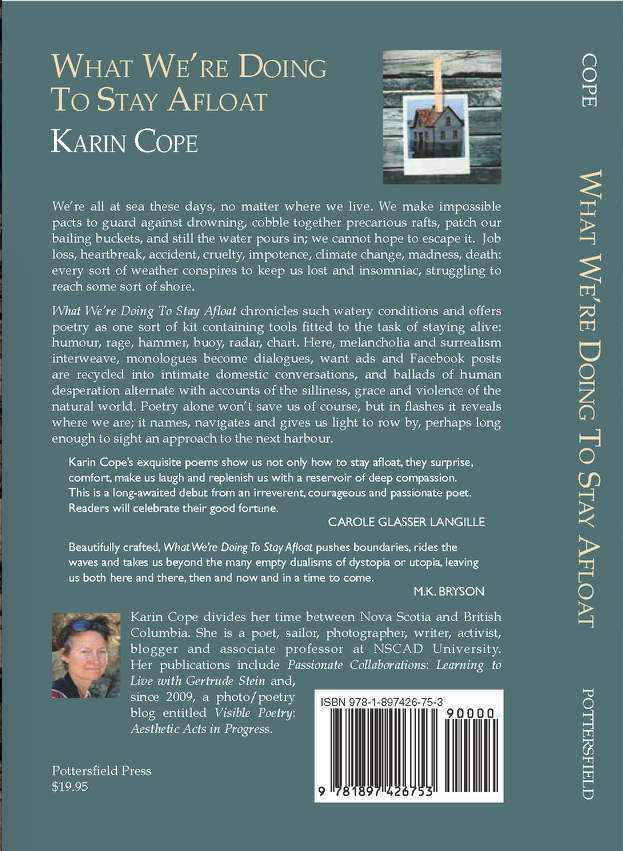
What we're doing to stay afloat--the book!!


Yes, it is true, by the end of October 2015, What we're doing to stay afloat will be available in book form. 


The end of September and it was all done: the pages checked and double-checked and the cover proofed in emails and phone calls back and forth between publisher, designers, copy-editor and me. Ten days earlier the version I'd corrected vanished from the book designer's in-box; for some reason her email server would not accept messages from any of my accounts. We waded through the details on the phone and I sent my marked-up copy from my partner's email account. Success! One more version to proof, which we did, and then everything was sent off to the printer. Now we wait, and sometime towards the end of October there will be a book, a tangible object to touch and to hold, to open, to leaf through, to read.

Where can you get a copy? You can email me, leave me a message in the comments section of this blog or via facebook messenger, or order a copy directly from Indigo Books here  https://www.chapters.indigo.ca/en-ca/books/what-were-doing-to-stay/9781897426753-item.html
or Nimbus Publishing here http://www.nimbus.ca/What-Were-Doing-to-Stay-Afloat-P7335.aspx


Meanwhile, I'm also planning, building a website for, and soon will be installing my first solo video installation, entitled Flows (Given Water).  The show features video haikus of meltwater, looped projections of shifting inter-tidal zones, and enormous silent projections of moon jellies propelling themselves through deep green seawater. The weather turns rainy, and my dreams, too, are submerged in water greens and dim anxieties: is any of it good enough? Have I worked through my ideas fully enough? Will others see what I see, or wish to stop and muse in these spaces of drift and damp? I hope, and will know more in time.

https://givenwater.wordpress.com/

Water, water everywhere--and yes, at the show, I'll be offering water (locally sourced, of course,) to drink!


Friday, August 28, 2015

Octavia's Brood: Science Fiction Stories from Social Justice MovementsOctavia's Brood: Science Fiction Stories from Social Justice Movements by Walidah Imarisha

My rating: 4 of 5 stars


Octavia Butler was the first well-known African American woman author of science fiction. Her work, always set in dystopic times and places very closely modeled on the contemporary US, nevertheless imagined other possibilities, including novel approaches to race, gender and species inter-relations. For example, Butler's Parable of the Sower (1993) uses the stories of an empath, a woman crippled by the pain of others, to argue that hope and regrowth must be possible, even at what seems to be the end of time. The book begins with words of wisdom from a holy book called Earthseed: The Books of the Living: "All that you touch is change. All that you change changes you."

Butler died in 2006; since her death, her influence and readership have continued to grow; indeed, those words of wisdom from the beginning of the Parable of the Sower have become an activist mantra of sorts, particularly among activists of colour in American cities. Octavia's Brood is at once a book and a project designed to introduce Butler's radical imagination to generations of new readers and activist-artists.

Octavia's Brood, the book, begins with Detroit-based co-editor adrienne maree brown's proposition that "All social justice work is science fiction. We are imagining a world free of injustice a world that doesn't exist yet." A tangible, printed companion an online presence (www.octaviasbrood.com) and a series of workshops, in which participants are invited to write science fiction as a part of their organizing and social justice work, Octavia's Brood is about the ways that art and culture allow us to time travel, to imagine others' lives, to revisit history, to cultivate alternative futures and alternative lives. Walidah Imarisha, Oregon based co-editor of the volume with adrienne maree brown, argues that science fiction is already at the root of survival for many people of colour in the contemporary americas: "And for those of us from communities with historic collective trauma, we must understand that each of us is already science fiction walking around on two legs. Our ancestors dreamed us up and then bent reality to create us" (5).

The collection is uneven--the idea of activism as science fiction is stronger than many of the stories that result from science fiction writing workshops with activists and social justice workers. But this does not really matter. As adrienne maree brown writes, "we hold so many worlds inside us. So many futures. It is our radical responsibility to share these worlds, to replant them in the soil of our society as seeds for the type of justice we want and need" (278). There is much to learn here.

Octavia's Brood is an important and necessary book, a crucial tool for teaching, thinking and (re)imaging past, present and future.


View all my reviews

Tuesday, June 30, 2015

Another kind of wildness


(Sonnet. Words yanked from "returning the books to their shelves" by Bernadette Mayer)

city          Feeling far from the city finally in Desolation.
time         Time to walk and stretch and swim and think until
19            19 o'clock in the evening
stream     when I hope we will eat a big fish you caught in the tide stream.
taxi          It's running so fast gulls taxi by
it              on blocks of driftwood; wing back; do it
mulch      again. Scent of kelp sea urchin and dessicated crab mulching
then         on the shore. The dog sniffs, then pounces cracking
window   shells with her teeth, each delicious crab leg a window on
nothing    another kind of wildness. Nothing can take this from her.
books       Like I here with my sketchpad and books,
cold         feet slippered against the cold, disregarding
phone      the insistent phone, opening turning
shelves    emptying the shelves of ordinary life.

I finish reading the 25th anniversary edition of Bernadette Mayer's wonderful Sonnets (Tender Buttons Press, 2014) while we are anchored in Desolation Sound. Despite their distance from where I am, Mayer's urban words and images suffuse my dreams, and I tap away at her lines, trying to understand how they fit together. One of Mayer's projects in particular, undertaken with Philip Good, strikes me: a list of fourteen words finds its way into a sonnet, one word per line (66). I decide I will try to co-compose with Meyer, by pulling words from another of her pieces that I love very much, a love sonnet entitled "returning the books to their shelves" (67).But as soon as I've decided on this method and pulled the words from Mayer's poem, I think, I can't make a poem from these words! I'm north of 50 degrees north latitude--what have I to do with cities, time, taxis, windows, phones or shelves? But as soon as I let the poem begin with that dilemma, the rest follows: being where I am lets me empty these words of their ordinary contexts and make other associations. Evidently, the neighbourhood is everything, no matter where you are.

Image: reflections north of 50.

Monday, June 1, 2015

Departure song


so much still to do...


I hold my breath before all of the things done to be done to be undone
before all of the things I've thought about forgotten or otherwise neglected

I hold my breath before doing or undoing what must be done or undone
before easy to finish tasks and difficult to finish tasks
before tasks that should be easy to finish but that are difficult to finish
before tasks that should be difficult to finish but that are easy to finish
I hold my breath in thinking of the dust under the bed
which I may or may not be sweeping up

I hold my breath before deciding
among the tasks that must be done or undone
what I am to bring with me and what I am to leave
what I must remember and what I may forget
(not leaving out how I may forget what I must remember)

I hold my breath before doing or undoing before undoing what I should be doing
and doing what I should be undoing
I hold my breath before hauling down or up the duffel bags
before opening them or closing them
and choosing and unchoosing what I am putting in them or taking out of them
before folding and unfolding clothing
before choosing and unchoosing sweaters
before counting and uncounting socks
before stacking and unstacking books boots and flashlights
before remembering and then forgetting the batteries

I hold my breath before taking or leaving what I am taking and leaving
before leaving what I ought to be taking and taking what I ought to be leaving
before zipping or unzipping the duffel bags and filling or unfilling them

I hold my breath before thinking of arriving
before leaving and thinking of leaving
before doing and undoing what must be done as I wish and do not wish to depart

I hold my breath before thinking of leaving
before arriving and thinking of arriving
before doing and undoing what must be done as I wish and wish again to arrive.