Freshwater freezes first, and near the shore, skims and plaques of ice form on the surface. They float in on the high tide and, then, as the water sucks back out, the ice is left behind to crack over rocks and barrels and tree limbs and other detritus.
At first the ice is very thin, and because it contains some salt, brittle, like shattered glass. Then it thickens, breaks, forms again, breaks, thickens, until huge boulders and pans of ice lie scattered across the beaches, an impassible wreckage, the sea a solid frozen mass without colour or visible movement.
Then the seals come deep into the bays to pup; we see them out on the ice, moving first one flipper, then another.
But we're not at that point yet. The icing up is just beginning here....Breaking, reforming, thicker than before.
Click on each small photograph to see a larger image in Flickr.
A: A fata morgana is an elevated, distorting mirage that usually appears over large bodies of water, grass or sand, though apparently it can be seen anywhere, even in the air from an airplane if the conditions are right. In a fata morgana mirage, islands or ships at sea appear to lift off of the water or to be stretched and stacked upon the water, typically in great layercakes alternating right-side up and upside-down forms.
Sometimes, fata morganas make objects appear where none are. One day off of the west coast of Greenland, for example, we saw, in the distance, what seemed to be a large modern city rising out of the sea. It looked as if Panama City had suddenly sprung up north of the arctic circle. No such thing was there of course; nothing at all was, although for a time, it looked as if numerous glass and steel towers clustered on some edge of land to our east.
This was not the first time sailors in the far north thought they saw things where there were none: in 1818, while hunting for the Northwest Passage, Sir John Ross arrived in Lancaster Sound and thought he saw a mountainous mass of land. Several of his officers argued that he was seeing a mirage, but he would not heed them, and because he thought he could not pass, turned around and sailed back to England. He named his vision Crocker Mountains, after a man who was then First Secretary of the Navy. A year later his first mate, William Edward Parry sailed through those mountains and further west, into the Northwest Passage, leaving the reputation of Sir John Ross in tatters.
Nearly a century later, in 1906, Robert Peary sighted what he believed was a land mass, which he placed at about 83 degrees north latitude and 100 degrees west longitude. Ironically enough, he called his vision "Crocker Land," though his Crocker was not the same Crocker, but a fellow in the Peary Arctic Club. Seven years later, in 1913, at great expense, Donald Baxter MacMillan launched the "Crocker Land Expedition," to find and chart Peary's imaginary landmass. They thought they found it; according to MacMillan's notes they saw "hills, valleys, snow-capped peaks extending through at least one hundred and twenty degrees of the horizon.” Piugaattoq, an Inuit hunter traveling with the expedition told the explorers that what they were seeing was "mist," an illusion, but, naturally, in typical arctic explorer fashion, they didn't believe him and pressed on for days through dangerous breaking sea ice. Finally they gave up, admitted Piugaattoq was right, and turned around.
Q: What causes a fata morgana?
A: Typically, warm air lies in a layer over the earth, while cooler air rises into the atmosphere. But sometimes, in calm weather, this order is inverted, and a layer of warm air lies above a significantly cooler surface layer. The sharp temperature gradient between these two layers may create conditions where what is called an atmospheric duct, a zone of refraction between the two layers, functions like a lens, bending light rays more strongly than the curvature of the earth. When this happens, you get fata morgana effects, in which reflections from the water or ice or land or air are refracted upward, from denser cool air towards less dense warmer air and stacked on top of one another or otherwise distorted. These can be photographed because they are not simply optical illusions, but real atmospheric effects.
Q: Where does that name, fata morgana, come from? What does it mean?
A: According to writer Morgen Jahnke, "Fata Morgana is the Italian name for Morgan le Fay, the half-sister of
King Arthur in Arthurian legend. Reputedly a sorceress and able to
change shape at will, Morgan le Fay was sometimes said to live below the
sea in a crystal palace that could also rise above the surface. The
fata morgana effect was so named for the superstitious belief among
sailors that she created illusory visions to lure men into a false port
and to their death."
The term was in usage in English in 1818, to describe a "peculiar mirage" that appeared in the Strait of
Messina, a narrow body of water between Sicily and the southern Italian region of
Calabria, and was locally ascribed to "a fay Morgana." Soon however, the use of the term was more widespread. Thus, for example, in 1873, in his poem, "Fata Morgana," a tiny fragment of a much longer work entitled Birds of Passage, Henry Wadsworth Longfellow writes:
The weary traveler sees
In desert or prairie vast,
Blue lakes, overhung with trees
That a pleasant shadow cast;
Fair towns with turrets high,
And shining roofs of gold,
That vanish as he draws nigh...
FATA MORGANA SEEN--Look, that island is standing on its head!
8 February 2012
Glittering sunshine, cold blue air. An edge of Ship Island lifts up off of the water like the sole of a shoe coming unglued. Not yet a fata morgana, but when the water gets colder, it will be. Funny how light shimmers in the heat or mimics water, tossing illusory puddles in the road, but elevates in the cold and mimics air, building fantasy castles and other odd forms.
I wonder if we find ourselves fascinated by mirages because they fight against the notion that our senses impart truths to us about the world. But when our senses show us things that aren't "really true," or "really just as they seem," it is perhaps not our senses that are out of order, but our interpretive capacities.
The positional information we receive from our senses rarely designates "true points," as any navigator knows. Everything is perspectival; everything lies in parallax. As you approach any object or island or land mass, shortening the angle of your view, the object's position seems to shift.
This is one of the pleasures and wonders and dangers of seeing. And drawing. What you see or what you sense is not as you think it should be, but as it is, elsewhere, according to some other logic, which is what you must then discover. Such labour of discovery is ultimately the work of living. Truly. Deeply. And yes madly. Who would want it any other way?
It is sunny, bright, cold; the frozen sea glitters and the snow-covered pond lies in blue shadows. Our salt-caked windows refract and soften the light, turn it golden as the tones in an old photograph.
We decide to walk across the barrens, as the spruce bog that stretches between Port Dufferin and West Quoddy is called here. Impassable to humans in all but a deep freeze, the barrens are anything but empty land. Coyotes live and hunt and pup in the bog; we've come across the remains of downed deer while skiing, and stood at the edge of the tamped down ring from whence the coyotes howl. And twice we've followed the tracks of a black bear through the snow. The barrens are not a place to be at night, but they're fine to explore in the midday sun, the dog trotting sniffing happily beside us.
Deep ponds extend beneath the roots of the spruces and other arctic succulents native to the bog. This is really a rough and brushy northern desert, a place that stores water and nurtures plants with hardy, spiny, even carnivorous properties, like the rare--though not here--pitcher plant, which lures insects with its flower, and then, when they tumble into the waiting tubular stem, digests them. Hillocks of juniper shelter tiny sheepskill bushes, and short trees, no higher than my waist, gnarl in the wind.
Lichen and moss-covered ridges of slatey stone run at odd angles across the landscape; taller spruce forests grow up in their lee, and are quite impenetrable, forcing us, and the deer, to meander in circles on the perimeters of the barrens. Now and then, despite the cold snap these last few days, we break through the ice to the black water below. Ice gathers on our boots.
It is easy to get deranged in this landscape. The bog appears to be a vast bowl surrounded by trees, though there are higher and lower sections, bounded--and thus hidden from view--by the ridges. The landscape can look the same as itself from any direction; often you cannot quite see where you are going, or where you have come from.
It is warm on the barrens; here, in this bowl, we are sheltered from the bitter northeast wind blowing across the water, and we stop now and then to turn our faces to light. We take the sun as our guide and listen for the sound of the road so that we know which way to turn as we wander from one deer trail to another. In this way we orient ourselves until we come to the edge of the barrens and see the backs of shut up summer cottages and an old barn, dripping icicles in the sun.
Elisabeth has been here before us; we see her tracks. With the dog in the lead, we follow her footsteps back to the house, and Marike heats up squash soup for lunch.
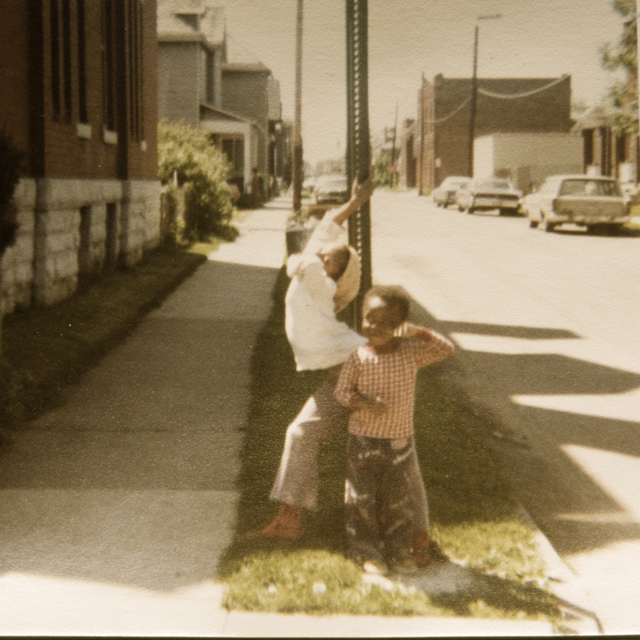
The summer I was twelve, my family left the suburbs, and with them, the good opinions of just about every friend, neighbour and relation, and moved into the inner city. This was a very strange thing for ostensibly middle-class white people to do in Columbus Ohio in 1976. Even if they were missionaries.
Our new neighbourhood was a forgotten place bounded on four sides by lately built freeways and freeway ramps. Those rushing from one end of the city to another no longer had to pass through our streets with their depressing and neglected tumbledown houses, and the yards full of junk, chickens, children and dogs. And so increasingly they didn't, unless they were looking for trouble or cheap sex and drugs.
The roar of traffic was constantly with us (I liked to imagine it was the sound of the universe expanding); so were police sirens, helicopters, fires, gunfights, afterhours joints, longhaul trucks leaking toxic sewage, and churches. That year I counted 84 places of worship within an eight block radius of our house.
The only sites more plentiful than places for prayer were vacant lots; in 1968, after Martin Luther King, Jr., had been shot, this neighbourhood, like so many other poor segregated zones in the country, burned for months with rage and riots. In later years, its houses continued to burn and tumble thanks to faulty wiring, old gas stoves, depressed or stupid people smoking in bed, murderous feuds, and general neglect.
There were no trees in the neighbourhood, save for the one across the street in the church yard, from which hung an old tire swing. Those hardy trunks we called "stink trees"--or less often, "trees of heaven"--like the other populous residents, roaches and rats, required almost nothing to survive in cracks in the pavement or garbage heaps.
The people who lived there were treated like their human equivalents: fearsome pests, for whom no respect or care was required.
Our stories were rich, but lives in the neighbourhood were short, rotten and rough. In fact of those I grew up with, almost no one survives, save those who joined the military or wound up sentenced to life in prison. Killing, it seemed, was about the only way out.
Notes
I took most of these photographs in the near East Side of Columbus Ohio in April and May 1977 with a little Kodak 110 pocket camera. The photos became a part of my first attempt at photojournalism, a 25-page essay entitled "The Inner City," a final grade 7/8 anthropology/English project.
Watching Richard Roy's Frisson de Colline, a recent nostalgic-melancholic film about a season in the life of a 12-year old boy in rural Quebec in 1969 made me think about my own experiences at the age of 12. I've barely begun, and already it's almost too much. Hard as life could be there then, for America's poor, it is much more brutal now still.
1. Me, at the age of twelve on our porch, crocheting. I'd tie-dyed my own shirt of course. I think my sister Lisa took this picture. 2. Man turning from 22nd street onto Main. 3. JP's Rib Joint, where in 1977, a whole slab of bar-b-qued ribs would set you back $4.95. 4. The Camel Bell Bar. 5. Laundry. 6. Larry with a balsawood airplane on the steps of First English Lutheran. 7. Back yards of houses on MacAllister Street. 8. Waiting for the free lunch program to open up and playing on the jungle gym in First English Lutheran yard. Sweet Meat [Sabrina] struggles up the "swinging bridge"; her older sister Dede looks at the camera. 9. Webby does Amanda's hair on the church back steps. With her, left to right, are Dede, Sweet Meat and Michelle. 10. Sue sits on her porch and laughs. 11. Next door neighbours Missy and Michael "just goofing" as I said in my 1977 essay. MacAllister Street and afterhours houses in the background. 12. The ice cream truck (Billy and Lynn). 13. Theresa, Mrs. Wallace and her baby. 14. Roger, Sue's son, and Billy, Larry and Theresa's brother. I wrote in 1977, "I told Roger I would take his picture when he didn't expect it." 15. Michael, eating a piece of cheese, with another friend, also--I think--named Michael.
Clouds always tell a true story, but one which is difficult to read. Ralph Abercromby, "Suggestions for an International Nomenclature of Clouds," 1887.
Saturday 21 January 2012--Water Pools in Dead Grass
Sun today, after snow and bluster and rain yesterday. It must be warm because the pond is slick and watery, though still frozen, snapping and groaning as the ice shifts. Blue sky; blue sea; blue ice. Frozen water pools in the dead grass, glitters in the sun. The ground is solid now, like rock, and won't absorb the rain.
Sunday, 22 January 2012--A Scattering of Snow
The sky is clear blue this morning, the light golden; a scattering of snow sparkles on the porch railings and floor, and swirls in strange looping patterns across the blue ice of the pond. Every contour is sharp, crisp, defined. At -11 it is cold enough that moisture has dropped from the air, and along with it, all haze. Another day of such cold and near stillness of wind and the sea will begin to freeze. Ducks swim in the shallows, eiders I think, but I would have to look through the binoculars to be sure. Out by the islands smoke rises from the sea, warmer water lifting into cooler air. A swath of brittle salt-ice limns the beach where the tide has pulled back.
Tuesday 24 January 2012 (Halifax)--Blot Out the World
A steady rain falls on the ice, the windows, the streets. Wind in the trees, standing water everywhere, the ice rotting and guttering, hiss of tires on pavement, darkness. A twilight day. A day to be home, to stay home, to huddle in bed beneath the eiderdown. Blot out the world. But I am not at home; I am here, in Halifax, and have to trudge to work soon. Cold feet, wet feet and a blown out umbrella--the joys of the day.
Rain. Rain. I listen to Bach's cello sonatas. The wind picks up, flings rain like pebbles at the windows. Time to get up and go now.
Wednesday 25 January 2012--The Sea is a Lung
Home again in woodsmoke and slush and yellow grass and damp earth and singing birds. High tide, and masses of seaweed are tossed up on the island, on the cove shore; they glow, rubescent, beneath grey streaky skies. Lines of light above the islands. A slight wind. Rain.
Sudden angle of near sun so that the porch floor begins to glisten, the water goes silver and the edges of things sharpen. And then it fades. A brief break of blue overhead. The last one. Seas nearly flat calm, just the motion of the tide rolling in, rippling the glassy surface. That movement always makes me feel as if the earth is breathing, as if the sea is the lung of the world.
Thursday 26 January 2012--Suddenly Sun Flashes
Blue light of a coming storm. Grey clouds, dull sea, a narrow streak of light across the sky to the south. Frozen pond. Suddenly sun flashes through thinning cloud and the sea glistens gold, a beaten brass pan.
Friday 27 January 2012--Descent into a Colourless World
A cold morning. The sea has frozen again nearly all the way to islands and shattered white sheets of ice, like glass, lie crumpled on the beaches. The sun is a pale white orb behind pale clouds; the pond and sea, too, are a whitened grey. Now is our descent into a colourless world. A storm is in the offing: snow, then rain then ice, oh joy. I am glad I do not have to come or go to the city today.
All night an eerie stillness as we wait for the wind to begin to sigh from afar.
Ralph Abercromby's comments on clouds are taken from Richard Hamblyn, The Invention of Clouds: How an Amateur Meteorologist Forged the Language of the Skies. London: Picador, 2002, p. 253.
I discover the "quick message" file on my cell phone and think it might make a good story if I rearrange the entries. What it makes is not "good" so much as funny. And every sequence leads to the same spot--I think--a leap into bed. Really? Sexting, it turns out, is inevitable. So too is sorrow. Where there is a telephone, someone is waiting. And nearly wordless.
Exchange I (Recycle.)
Where u at?
B there soon.
Tipsy?
I'm gonna B late.
What's up?
Booty call.
U know u want me.
RU up 4 it?
Your place or mine?
Let's do it!
Exchange II (Repeat.)
Do it! You up?
Your place? Yours. Gonna be late.
Where are you? Boy call.
Again? B there soon.
Exchange III (Restraint.)
Soon be there
Want up
Call do
You too
Late
Photos are of a plastic drop cloth hung out to dry. September, 2011, Halifax.Recycled plastic; reusable words.
Let me be clear; it is she--Sophie Calle--who asks these questions. I simply answer, as truthfully as I can. (I'm sorry if you don't believe me. You should.)
--When did you last die?
--Late last night, three hours before the moon set. And then I woke again.
--What gets you out of bed in
the morning?
--In this season? The thought of getting back into it at night. And sometimes the promise of a hot eucalyptus scented bath. Coffee keeps me up, as does the endless list of tasks life has handed me. I cross one off, and it adds three. Or five, or ten. This is why I have to die every night; it is a way of resetting the clock. But, alas, the list survives.
--What became of your childhood dreams?
--They were all nightmares from which I am glad to have awakened.
--What sets you apart from
everyone else?
-- Nothing. I wear others' castoffs, and can hardly remember the last new pair of shoes. In any case, I will surely fit into another pair someone else has tossed aside.
--What is missing from your life?
--Nothing and then everything and then nothing again, so that I tumble into a quandry without top or bottom.
--Do you think that everyone can
be an artist?
--Of course. Everyone but myself, naturally. Which is why I must make such an effort to insist that I too might someday think of myself this way. Just not yet.
--Where do you come from?
--I grew up in a flat place south of this one, a thousand miles from the sea. The lights of the city blocked out the stars, and I thought that the endless roar of the traffic was the sound of the void.
I was, perhaps, right about that.
--Do you find your lot an enviable one?
--I have no truck with envy, though desire is everything. Can you desire a lot? Yes, I do.
--What have you given up?
--Lent. Small purchases. And often, hope.
--What do you do with your money?
--I put it into a household account and there it disappears. I am not sad about this; what else should I do with my money?
--What household task gives
you the most trouble?
--I loathe vacuuming, spot removal, scrubbing the bathtub and fixing other people's computers. And correcting grammar mistakes. Yet I seem to be an expert in all of these things.
--What are your favourite pleasures?
--You really think I'm going to tell you? Okay, I relent. One is....dancing. Nothing makes me happier. I wish I had been a choreographer. Or had known Pina Bausch.
--What would you like to
receive for your birthday?
--A complete set of poetry by CD Wright. And a really sturdy tripod. And perhaps a new pair of shoes all my own. Or a swimming pool; the sea is really too cold for sport these days.
--Cite three living artists whom you detest.
--Artists? I can't think of one. But politicians, managers, corporate kleptocrats? May an infinity of evil befall the lot of them, they who are the evil that shatters us. You want me to name them? Ayy, where do I begin? Just pick up the newspaper and check off the names on the front page.
--What do
you stick up for?
--Virtually everyone else.
--What are you capable of refusing?
-- Butter. Sugar. Cream. A ride. I wish I were capable of refusing stupidity, but sometimes I tumble into it and cannot get out.
--What is the most fragile
part of your body?
--My feet. Or perhaps my breath. This is why I didn't become a dancer, although I still long for such precise athleticism. Words rarely fail me, but my body lumbers; it is less reliable than it used to be.
--What has love made you capable of doing?
--Love has made me capable of hatred. Of rage, of going to battle. Strange perhaps, because the opposite is not true--rage and hatred don't make you capable of love.
--What do other
people reproach you for?
--Unfinished projects. Belatedness. Abstraction. Absence. Falling down when I should be standing up. Loving the wrong things. And they are right. I reproach myself for these failings too, among many others.
--What does art do for you?
--It is sometimes the only door to hope. Without it, I don't think much of human beings.
--Write your epitaph.
--Wait, that's not a question. I would prefer not to. Not yet, though as I've said, I do sometimes die every night. See? Another unfinished project. A belated requiem. Let us sing.
--In what
form would you like to return?
--As a winged thing, fleet of foot; nimble, pirouetting, light of heart, ripe and tender like a peach in July.
What if we thought of poetry as something visible everywhere? Much of what we call poetry IS blogging, a lyric voice meandering through the sounds and images and movements of the world, trying on sensations and seeking interlocutors. Visible Poetry: Aesthetic Acts in Progress aims at expanding some horizons of this oldest of forms.
The Green Ocean Waters (More Georgetown Memories)
-
The Green Ocean Waters (More Georgetown Memories)Transposed from part 2 of
Li Bai’s Changgan Memories intothe voice of 19th-century Prince Edward
Island wo...
Six poems from Sue Goyette
-
We feature a folio and a conversation with the Halifax poet. Originally
published December 12, 2017. I’m reposting now in anticipation of a new
review of F...
To Alaska and Back I: Getting underway
-
It was wonderful to be back in the "land of the big trees;" each evening,
after our chores, we walked around the docks or wandered the neighbourhood.
One n...
Lexicon -- An Exhibition of Weavings by Bhakti Ziek
-
I have a new exhibition up at BigTown Gallery in Rochester, VT from October
26 - November 26, 2016. It is called *Lexicon* and includes new weavings as
wel...






 Posts
Posts


