Wednesday, December 30, 2009

Arctic Adventures--From Northern Greeland through Canada's Northwest Passage


Three articles by KARIN COPE and MARIKE FINLAY-de MONCHY
(first published as a SUNDAY SPECIAL to the Chronicle Herald --Halifax, Nova Scotia Canada)  


I. High Arctic Revelation
Summer in Greenland overturns all expectations, illusions of northern waters
Sun. Dec 13 - 4:46 AM
 

Ilulissat, Greenland, nestled in the rocks, resembles a Nova Scotia fishing village.

The Clipper Adventurer. (Photos by KARIN COPE)


A mountainous iceberg in Ilulissat ice fjord.


Shipmates look like dots on the landscape while the ship is dwarfed by the mountains surrounding Karrat Fjord, Greenland. (Photos by KARIN COPE)


EDITOR'S NOTE: First in a three-part series about a voyage to the Arctic. Next week: birthplace of icebergs.

GREENLAND LOOMS over the map of North America, more than two million square kilometres of ice and rock, the largest island that is not a continent. With just 57,564 inhabitants, it’s the least densely populated country in the world. Who wouldn’t jump at the chance to go there, particularly during the summer, the season of the midnight sun?
Is it true what we’ve been hearing, that northern waters will soon be ice-free? Should adventuresome ordinary sailors be tempted into Baffin Bay and beyond?

We wanted to find out, and so we signed on for a 22-day cruise with Adventure Canada aboard a Russian-built ice-class vessel, the 118-passenger Clipper Adventurer.

The itinerary called for us to fly from Ottawa to Kangerlussuaq, Greenland, an international airstrip deep up a long, ice-free fjord where we’d board the ship. We were to sail up the west coast of Greenland as far as ice conditions permitted, stopping to explore various capes, fjords and islands.

Then we’d cross to Ellesmere Island, officially re-entering Canada in Grise Fjord, Nunavut, the northernmost community in the country.
A second leg of the voyage called for us to nose our way through the Northwest Passage, stopping for ancient archeological ruins as well as abandoned Hudson’s Bay Company and RCMP posts. We were also to spend time in northern hamlets from Resolute to Gjoa Haven and Cambridge Bay.

Although we’ve read many accounts of the north and are avid admirers of Inuit art, we had no idea what to expect. The north remained sketchy, unimaginable territory, a wild fantasy zone populated by deranged explorers, pelt-wearing hunters and ever smaller polar bears drifting on disappearing ice floes into a midnight sun.

Greenland was a cipher and the Canadian north nothing more than a series of large blank wedges on the map, sparsely populated frosty territories where grave social and environmental problems seemed to be unfolding.

If we prepared for anything then, we prepared for tragedy. But what we found were spaces so beautiful, so vast and so stunning that our sense of the order of the world has been utterly and completely altered.

There is a reason why travelers to the Arctic tend to return, inflamed by arctic fever. Nowhere else in the world is like this. It will defeat and reverse and meet every expectation you could possibly carry. This alone makes the trouble of the trip worth it. And yes, you will see polar bears and narwhals and bird colonies consisting of hundreds of thousands of individuals, and thousands upon thousands of icebergs glistening bluely in the sun.


It was late evening in early August when the Clipper Adventurer hauled anchor and began to steam the 168 kilometres down the Söndre Strömfjord to the sea. The temperature was a balmy 17 C and the sun was still high in the sky. (We were relieved by the warmth — we did not expect that — but also worried. Was this evidence of global warming or just summer in Greenland? In a month, we heard, it would be zero again.)
Energized by such intensity of light so late in the day — who expects to see shadows near midnight? — and the excitement of being in the Arctic, we remained on the deck throughout much of the night, watching as the ship ghosted between high cliffs of ancient metamorphic rock.

A guide told us that Greenland was the site of an ancient northern "ring of fire;" these cliffs in the fjord were some of the oldest visible rock in the world; more than one billion years old on the north side, and nearly three billion years old along the southern wall.

The sun set at around 11:30 p.m. but rose again at 2:30 a.m., so the sky never really darkened.
We waited above-decks to see what was around the next corner and then the next, and the next.

Each view was more extraordinary than the last: clear blue-green glacial waters, multicoloured cliffs marked by striking vertical black slashes, thickly grooved white glaciers flowing into the fjord or retreating up the mountains, a ruby ball of reflected sun striking ice, a cliff face, another cliff. And then, as we approached the sea, our very first "bergy bits."

The next afternoon we stopped at an abandoned research station in Faeringe Nordhaven Fjord. This was our first real walk on the tundra, our first real view of a landscape above the tree line.


Here’s what struck us about the tundra: how familiar the springy, peaty soil made of composted plant matter clinging thinly to bedrock, the fatty tiny leaves of northern succulents like Labrador Tea, the cornucopia of blueberries and crowberries, the stunted growth of the brush, the low carpet of brightly-coloured leaves, grasses and mosses; all were exaggerated reductions of much of the vegetation found on the windy, barren coastlines of Nova Scotia. Minus the ubiquitous black spruce, of course.

There’s a running joke in the Arctic: "If you get lost in the woods just stand up." Tiny arctic willow and dwarf birch trees, trunks no wider than your little finger, crawl horizontally along the rock. Because the trees are so small, you can see forever.


We were startled by an arctic hare on a ledge, watching us, its ears enormous, its fur brilliant white. Snow buntings and wheatears flitted from cliff to cliff. We waded through bogs filled with cotton grasses, photographed bright pink dwarf fireweed and lavender arctic harebells no larger than a thumbtack, picked edible mushrooms, tasted leaves, swatted midges.

"Everything is edible," our guide, artist and adventurer Jerry Kobalenko, reassured us.
"In the Arctic, no plant can waste energy creating the complex proteins that make up poisons."

Before heading back to the boat we climbed the highest ridge and looked around.
Our shipmates were tiny specks, like us. Water pooled on the ground everywhere, and echoed the landscape back to us: vast, lush, verdant, frozen.


II. Greenland’s iceberg factory
Glaciers spill into ice fjords filled with wildlife in a northern wonderland
Sun. Dec 20 - 4:46 AM
 

Ice plugs Karrat Fjord. Just visible in the background is the glacier responsible for much of the ice in the fjord. (Photos by Karin Cope)

Pakak Inukshuk and Aaju Peter perform a drum dance among the remains of an ancient Thule camp at Dundas Harbour, Devon Island, Nunavut.


The Greenland fishing village of Ilulissat.


EDITOR'S NOTE: This is the second of a three-part series of stories about a voyage to the Arctic Ocean by Eastern Shore writers Karin Cope and Marike Finlay-de Monchy. Next week: Sea ice and polar bears off Ellesmere Island.


WE WERE surrounded by thousands of icebergs.
As we headed north along the west coast of Greenland, the Clipper Adventurer steamed through a vast field of towering white fantasias, some trailing streaks of mud. Others seemed to emit a blue glow, above and below the water. Some were rough, some were smooth, some flat, others spiky. Sometimes, you could hear the ice hissing as it melted into the sea. Now and then, with a thunderous crack and splash, an iceberg split apart or became top-heavy and turned over.

Disko Bay, on the west coast of Greenland and 250 km north of the Arctic Circle, is one of the most prolific iceberg factories in the Arctic, and because the movements of the ice stir up the water, it’s also very rich fishing grounds.

Here, inside of Ilulissat Ice Fjord, an enormous glacier called Sermeq Kujalleq runs, like a massive river, from the ice cap to the sea. This is the most active glacier outside of Antarctica; every year, 35 cubic kilometres of ice flow into the sea here, where they crack off and create icebergs. As the icebergs calve, they crash and bang and create small tsunamis — signs on the beaches near the town of Ilulissat warn visitors to step back lest they be swept away.

We docked in Ilulissat, a shrimp and fish packing town with a population of around 5,000, and walked through town to the cliffs above the Ice Fjord, where thousands of icebergs are grounded against the sea bottom. They looked like the work of a mad city planner; huge glowing white architectural monuments ranged row upon irregular row.

Later we surveyed the Ice Fjord by Zodiac. Ice monsters — or perhaps angels — hovered over us. Light tumbled through strange keyholes high in the ice walls and bounced from one point to another. Newly calved icebergs were crusted with mud and stone; older bergs that had already rolled were smooth and sharply curved and clean. We traveled slowly among the behemoths, quietly, trying to keep a safe distance, in case they should roll or break apart.

Ice wasn’t the only attraction above the Arctic Circle, however. The air was warm (10-17° C) and the sun never set. Cam Gillies of Eagle Eye Tours helped us to see and identify kittiwakes, fulmars, guillemots, ivory gulls, gyrfalcons, snow buntings, harbour seals and bowhead whales. We saw polar bears and muskox and three small fox kittens.


All the coastal towns we visited in Greenland — Ilulissat, Upernavik, and Qaanaaq — featured small brightly painted wooden houses, in deep blues, yellows, rusts, greens, ochres and reds, scattered across the bedrock. Steep staircases run up and down between the dwellings, and large insulated pipes carry power and communications lines across the rock.


We were welcomed warmly in every community by emissaries who came on board to greet us, to eat with us, to sing with us, and, in Upernavik, to challenge us to a soccer game. The Adventure Canada team was roundly trounced by a changing crew of fishermen and fish packers on lunch break, a man who scored a goal against us while taking a call on his cellphone, a mom with a toddler, and several elders.

Adventure Canada had secured the services of Aaju Peter, a Greenlander now living in Iqaluit, Nunavut.
A singer, clothing designer, legal student and able cultural interpreter and translator of English, Inuktitut, Danish and various Greenlandic dialects, Aaju traveled with us, taught us words and songs in Greenlandic and Inuktitut, and facilitated a number of conversations and exchanges with residents of the communities we visited.


In Greenland, where it is legal to sell wild game, Aaju often went ashore to purchase fresh musk ox, reindeer, Arctic char, and halibut for the ship’s galley. And one afternoon, on the tundra steep above an icy fjord, she spread a table of "country food" delicacies for us to sample: raw seal and whale meat. (Cooking this food is not only disgusting, according to most northerners, but it destroys all of its vitamins and essential nutrients.)

At 77° north, Qaanaaq is the northernmost hamlet in Greenland. Squeezed between mountains and the sea, the town spreads across desertic scree. Removed 153 kilometres from more hospitable terrain in 1953, to make way for the U.S. Cold War Thule airbase, Qaanaaq’s inhabitants survive by hunting narwhal, seal and long-line halibut fishing.

Housed in a building once inhabited by Knud Rasmussen, a small museum showcases the history, artifacts and artworks of the community. Here you can see explorer Robert Peary’s ethnographic portraits of his young Greenlandic wife in various states of "native" undress. The museum also details Peary’s theft of the bulk of an iron-rich meteorite that had supplied inhabitants of the entire Baffin Bay region with iron for tools for more than 1,000 years.


Qaanaaq might be remote, but it is not out of touch, nor have its residents ever been. Many of the "great" northern explorers and whalers owe their survival to the ingenuity, hospitality and hunting skills of these "Arctic Highlanders" as John Ross called ancestors of this community in 1818.

Today, Qaanaaq is home to the world’s northernmost breakdance crew. Dressed in unlaced high tops, slouchy pants, graffiti shirts and cool sunglasses and copping moves from Brazilian capoeira, these talented teens are obviously global citizens. They gave us an impressive show.

How far north did we get?

At 78° 13’ north, in the early morning in thick fog, the ship stopped with a mighty crash as we lurched up against impassable floes of very hard multi-year ice descending from the polar ice cap and clogging the narrows of Smith’s Sound.

For the last century or so, often ice-free in the late summer, this passage was, ironically, thanks to climate change and the increased melt and breakup of the polar ice cap — clogged by old, super-hard ice.
There was nothing to do but to turn around and head south until we could cross to Ellesmere Island.


III. A harsh beauty
Arctic exacted tribute from early explorers

Sun. Dec 27 - 4:46 AM
 

A view of Gjoa Haven from the beach on a foggy August day.

Graves of RCMP officers from the 1920s overlook Dundas Harbour. Apparently, the officers went a bit mad. It seems that one shot the other then committed suicide,* though of course, since they are both dead, no one else knows exactly what happened. (* In fact, this is incorrect--see end of article for correction.)


Passengers from the Clipper Adventurer cross the tundra to an abandoned RCMP post in Dundas Harbour, Devon Island, Nunavut. Fresh polar bear tracks have been sighted, so guide Aaju Peter carries her gun. (Photos by KARIN COPE)


EDITOR'S NOTE: Third and final part of a series about a voyage to the Arctic.

HEADING SOUTH through sea ice along the east coast of Ellesmere Island was hard. In fog, the Clipper Adventurer slowly hunted for leads along the floe edge. Occasionally we spotted a lone male polar bear on the pack ice accompanied by rare ivory gulls hoping for remnants from a seal catch.

At Coburg Island, we took a late-night Zodiac trip along high cliffs where thick-billed murres and other seabirds nest. Along with Prince Leopold Island in Lancaster Sound, Coburg contains a crucial rookery for seabirds feeding on fish, squid and shrimp in the storm-stirred Arctic. The sunny midnight sky was filled with half a million screeching parents and their fledglings.

We cleared customs at Grise Fiord, the northernmost Inuit settlement in Canada. Like Resolute, one of the coldest inhabited places in the world, Grise Fiord was created in 1953 by the federal government to ensure Arctic sovereignty claims.

Several families from subarctic Hudson Bay and Baffin Island had been assured of housing and ample game in these new hamlets.
When they arrived, there were no buildings. After great hardship, hunters learned where to hunt beluga and narwhal. These were northern deserts.

Years later, after an inquiry, compensation was paid to these settlers, but no formal apology ever offered. Despite government subsidies, housing, nursing stations, schools, air service, the annual sealift, and social insurance, living here is still a great challenge, especially for increasing numbers of youth who have few local employment prospects and little experience of the outside world should they finish school and decide to leave.

Devon Island, the largest uninhabited island in the world, is separated from Baffin Island by Lancaster Sound, one of the world’s most nutritious feeding grounds for marine animals. The RCMP station at Dundas Harbour, established in 1922, consists of derelict buildings and a well-tended graveyard. The site was abandoned after just ten years following the suicide of one officer and the death of another.

On Beechy Island we visited gravesites of three members of Franklin‘s 1845 search for the Northwest Passage. Even in the height of this tundra-flowering, luminescent summer, Dundas and Beechy seemed barren and desolate. In 1846, all 129 members of Franklin’s expedition perished. Ironically, the Canadian Arctic archipelago was charted by 81 subsequent expeditions launched, at huge expense, to search for Franklin or to relieve searchers.

During the long cold run through Peel Sound between Prince of Wales and Somerset Island, we studied ice charts from Environment Canada revealing extensive ice coverage in Bellot Strait.


Luckily the strait was sufficiently ice-free to enter. Afternoon sun at our backs illuminated high red rocky hills on either side. As we passed the northernmost point of continental North America, extremely strong eddies caused by the meeting of tidal waters from both the Atlantic and the Pacific stirred up many nutrients, attracting a plethora of marine life. Polar bears, including mothers with cubs, fished from ice floes or wandered high in the hills. Narwhals crossed our bow and grazed like slowly moving logs along the shoreline, their strange tusks barely visible. A bowhead sounded. Dozens of belugas spy-hopped, popping their white heads in and out of the swirling water.

Fort Ross, a Hudson Bay Company fur-trading post, established in 1938 and abandoned two decades later due to intractable ice conditions, lay at the east end of Bellot. Now derelict, it was obvious that the main house had been built to impress. The oval door frames, desks and cabinetry were crafted of fine woods. An adjacent building, in good repair, shuttered against marauding polar bears, still provides shelter for hunters, fishermen and sailors. Inside we found a working oil stove, plenty of fuel, bunks, a functional stocked kitchen, a logbook, even a bottle of rum!


Heading south through the Franklin, Ross, and Rae Straits, the fog froze on the deck. A northerly had blown broken-up ice from the high Arctic down through McClintock Channel and into Larsen’s Sound, named after Captain Henry Larsen nearly lost his ship, the RCMP vessel St. Roch, in the crushing ice of these waters. The second vessel to complete the Northwest Passage, the St. Roch was the first to do so in both directions.

Adventure Canada had insisted on hiring Capt. Kenth Grankvist, a Swedish ice master with 30 years of experience. Unlike many captains, he loves to work ice. For 36 hours in thick fog he never left the bridge, searching for leads through multi-year ice. Occasionally the hull met ice with a crash.


Finally the sky and the ice cleared as we approached Gjoa Haven, a sheltered harbour on King William Island. Elders and schoolchildren performed throat-singing and drum-dancing, then fed us fresh bannock. We learned about a birthrate so high that housing and medical care cannot keep pace. Prices for fresh fruit, vegetables and milk in the Co-op and North stores are outrageous. Life is hard here; each Canadian Arctic community we visited left us with many questions and no real answers.

The coast guard icebreaker Sir Wilfrid Laurier, in narrow, shallow, twisting Simpson Strait, was just beginning to set and repair buoys for the late summer sea-lifts of heavy objects and fuel to northern communities.


On Jenny Lind Island, in Queen Maud Gulf, an abandoned DEW Line radar station, originally designed to detect Soviet nuclear bombers, was being dismantled.

A hike on vast Victoria Island revealed caribou and tundra swan. At Prichard’s Point we came upon a well-preserved wreck and our first driftwood, flowing up from below the tree line along the great northern rivers.


We travelled by zodiac up the Coppermine River to Bloody Falls, site of a massacre of Inuit by Dene hunters accompanying Samuel Hearne in 1771. Later, the summit of a red-bushed mountain revealed the winding path of the mighty Hood as it reached Arctic Sound.

At longitude 118° 13’ W, just before Amundsen Gulf, we toasted Amundsen’s first Northwest Passage as well as our own; it is still a navigational challenge, history in the making, and a life-altering experience of natural beauty!

Marike Finlay-de Monchy and Karin Cope are freelance writers who live on Nova Scotia’s Eastern Shore.


*Correction*

According to RCMP records, it is not really true, as the caption for the Dundas Harbour RCMP gravesite above states, that the officers buried in the graves at Dundas Harbour "had gone a bit mad" and were involved in a murder-suicide.  

The true facts are as follows:  The RCMP maintained an active post in Dundas Harbour from 1924-1933 and then 1945-1951.  The post at Dundas Harbour was part of an effort by the federal government to assert Canadian sovereignty in its northern archipelago.  While there are some signs of ancient encampments on Devon Island, prior to the establishment of Dundas Harbour detachment, there were no modern inhabitants on the island.  Life there was certainly lonely and very difficult.  In 1925, Inuit special constables and their families were assigned to the unit to help southern officers with the survival skills necessary to live in such a remote region of the north.

In June 1926, Constable Victor Maisonneuve committed suicide.  He was alone at a seal hunting camp at Croker Bay at the time. Then, a little more than a year later, in August 1927, Constable William Robert Stephens accidentally shot himself while hunting walrus.  Although the RCMP no longer maintains an active detachment in Dundas Harbour, the Arctic Bay detachment is responsible for making an annual grave inspection there.  As you can see from the photo, they maintain the graves very well.  Permanent granite headstones were put in place by the RCMP in August 1973.


I thank the Rev. LCDR (ret.) MacLean for bringing suggesting something was amiss with the story and requesting a correction to the record. I alone am responsible for the error; Marike played no part in my late and fanciful edit of the details at Dundas Harbour.

Karin Cope


Monday, November 9, 2009

Photographic Excesses

Straddling a puddle at Taylor's Head Park, Nova Scotia

I've been taking lots of photographs lately. Since July, hundreds and thousands of them--twelve gigabytes of digital record (or some 3000 + images) during the three weeks we were in the Arctic for example, and probably at least half as many again since then.

Professional photographer Rob Poulton shoots moving ice; we shoot him

I was not the only traveler on that trip so electronically voracious. The voyage was billed as a photographic opportunity; view and record animals, people and places rarely seen. A northern safari, packed to the roof tiles, as safaris are, with colonial baggage and a loose, if mostly misplaced sense of danger and daring.

Some of our fellow passengers were professional photographers; others were simply affluent and passionate amateurs with, in some cases, tens of thousands of dollars worth of professional equipment--lenses of a variety and quality I'd never before seen. In this environment, it was virtually impossible to be anywhere--even long after midnight, for of course the sun did not set in August above 75 degrees north latitude--without someone clicking away.


An iceberg? Click. A bergy bit hissing as it dissolves in the sea. Click. A polar bear too far away to look like more than a yellow-white smear against the pack ice. Click. A rumour of muskox in the distant hills. Click. Mossy caribou horns or a stripped and perfectly clean skull. Click. Narwhal swimming along the bow. Click. Polar bear skins hanging on a clothesline. Click. Children crowding into a community center, hoping to get a couple of mouthfuls of bannock. Click. Barges carrying away dismantled bits of an old DEWline station. Click. An abandoned Hudson's Bay Company post, a gravesite, another, a rusted bucket on the beach, a desolate and now disbanded RCMP detachment post, seal skulls littering the yard. A rotted Singer sewing machine. Oil drums everywhere. Click. Click. Click. Click. Click. Click. Click.

Polar bear on pack ice

Muskox skull

I have photos of all of these things. Some are lovely. All are thrilling to recall. But I did start to think that things were getting out of hand when dozens of passengers repeatedly fled dinner or conversations or other activities to rush on deck and snap photos of one thing or another. Even as I too, joined them.

Girls in caribou parkas, Grise Fiord, Nunavut

Align Center
Abandoned Hudson Bay Company outpost, Bellot Strait, Northwest Passage

Some entrepreneurial types began to stage events for the cameras: catch this leap over the outcrop at 74 degrees north! Strange creature appears in the bush, will arabesque for shutterbugs! You'd see the mad rush of bodies and tripods stop and start over the treeless autumnal landscape, stutter along the ridges, mass and scatter like a tiny lost herd of caribou wearing muli-coloured gum boots.

Abandoned materials from abandoned Hudson Bay Company and RCMP sites in Nunavut

During our waking hours (which were many--who sleeps when the sun doesn't set?) we strapped our cameras to our bodies as if they were heart monitors, jumping up every time something, anything, oh my heart, skipped a beat. It started to seem like a sickness, a mortifying illness: no rest for any body, here. You could not point without a host of cameras turning, shooting, often before their operators were fully engaged. Marike began to complain of being abandoned to walk or eat by herself, a widow to the camera.

Houses in Qaanaaq, Greenland

I began to long to stay in a place long enough to sit quietly in a corner and draw. Muse. Inhabit the landscape. But there was no time for that--we traversed more than 3500 miles in 22 days--and so out came the cameras to keep the traces of a record. Impossible to remember so much clearly otherwise. The images became a memory deposit, a place to leave the previous days as we rushed onward, to the north as far as we could go and then west through the northwest passage.

Filmmaker Steve Smith captures a soccer game in Upernavik, Greenland

At some point during the voyage--when we were smashing slowly up against pack ice in fog in Smith Sound, between Greenland and Ellesmere Island--I happened upon what seemed an appropriate text in the ship's library: a chapter in Alain de Botton's The Art of Travel (Vintage, 2002) entitled "On Possessing Beauty." Since there was nothing "out there" to see but fog, and, like anyone who has lived in Nova Scotia for some years, I've seen more than my share of that, I fell upon the book with a voraciousness previously reserved for the view.

De Botton reviews Victorian art and social critic John Ruskin's reflections on "the traveler's dilemma": "how is one to possess beauty?"--which is to say, how is one to relate to the things one sees or encounters? How indeed?

On the Coppermine River

Apparently, as a young man on his first "continental tour" to Italy, Ruskin developed an enormous enthusiasm for the camera, then a brand new bit of technology. He wrote to his father about how "faithfully" the camera might capture images of the architecture of Italy; such "true" copy would surely alter the arts forever.

Very soon, however, Ruskin turned against the camera eye, characterizing it as a "lower" order expression: to take possession of something by photographing it was akin to scratching one's initials into a tree truck or a table top. The only way, truly, to possess beauty--or even to see it really--Ruskin began to argue, was to try to understand it, to try to meld, consciously, vision, affect and intellect. Such a relationship could only be achieved by writing or drawing: slowly, painstakingly learning to see, to apprehend relationships between spaces, persons and things, within and despite appearances.

Kap York, Greenland

Drawing or writing were metabolic acts--one pulled the delicious external into oneself and digested it slowly. As Ruskin put it, drawing was something he did on the basis of "a sort of instinct like that of eating or drinking." And like eating or drinking properly, it took time--and the time it took was, at once, essential and a pleasure.

In fact, Ruskin would be still more pointed about the uselessness of accessing landscape at great speed: "No changing of place at 100 miles an hour will make us one whit stronger, happier or wiser. There was always more inthe world than men could see, walked they ever so slowly; they will see it no better for going fast. The really precious things are thought and sight, not pace. It does a bullet no good to go fast; and a man, if he be truly a man, no harm to go slow; for his glory is not at all in going, but in being" (Ruskin, cit. de Botton, 218).

Cemetary, Upernavik, Greenland

The problem with photography then is that it can infinitely multiply its views without ever, necessarily, entering a digestive stream. To click is not to see; to click is not to know; to click is simply to capture something just there, then. The danger of photography, according to de Botton, is that "rather than employing [photography] as a supplement to active, conscious seeing, [we tend to use] the medium as a substitute, paying less attention to the world [than before]...The camera blurs the distinction between looking and noticing, between seeing and possessiong.... It suggests that we have done all of the work [of looking, thinking, apprehending, understanding] simply by taking a photograph" (de Botton, 219-220). It is, at bottom, a species of conquest, a narcissistic claim: here was I, I was here, suffer my record.

Late night napping, Marike photographs Karin

There is something to this argument, however wrong-headed it might also be, for it doesn't take account of the digestive review: the editing, cropping, representing, selecting, presenting aspects of photography, the way these images play and replay, instigating--as here, as elsewhere-writing and other undertakings.

Gumboots on the beach

But it is also true that to see with the camera eye can become an obsession. What it sees is not what you see--I've begun to look at things as it might see, to pick out and get better at planning for its eye--or rather, particular lenses' eyes.

My own continue elsewhere, too. Thankfully.


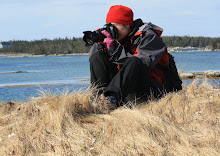
Photographer-author at work

Links to Karin's Arctic photos:
http://picasaweb.google.ca/karin.cope/GreenlandHighArctic?feat=directlink
http://picasaweb.google.ca/karin.cope/HighArticImagesAugust2009GreenlandCanada?feat=directlink
http://picasaweb.google.ca/karin.cope/NWPassageEToWAugust2009?feat=directlink

Rob Poulton's site: www.rpoulton.com

Wednesday, October 14, 2009

How (Not) to Grade Papers


It's that time of year again. The days are shorter, the nights longer, the storms more violent, the leaves more vibrant. And slapping up against your desk--yes! here it comes!--a tidal wave of student papers. Here's your seasonal guide for wading through the mess: How to Grade Papers.


As soon as you get them, page through them with great anticipation.Then stuff them in your pack and carry them all day every day for as many days you can manage.The weightier the load the better; hauling enormous quantities of student papers on your back builds both character and muscle mass.

It's important to keep your papers with you at all times. You never know when you'll get stuck in traffic, hung up at the airport or forced to do time in a hospital waiting room with a kid with a broken arm. A pack full of reasonably fresh papers could save you from the germ-ridden copies of National Geographic, circa 1976, that hold down the tables of at least six of the better-known radiologists in town.

When finally the day of reckoning comes--you've promised to return the papers TOMORROW--take your time. Warm up to the task slowly. Stretch. Try to remember a few yoga moves. Start your day with breakfast (always a good idea) and a strong pot of coffee. Take in the mail, a load of wood, build up the fire. Take out the trash. Sort the recycling. Do a load of laundry. Check your email. Hang out the laundry. Go back to your computer: where was it that great-aunt Ruth lived? Has Googlemaps photographed that street yet? Plan where you will take your winter holiday if you can ever afford to do so. If you haven't done so yet, download that fancy Googlemaps flyer feature (already several years old) and surf low, lower over the Andes. Oops! Smash! Cloud cover. Land in the Pacific. Worry, briefly, about how quickly the day disappears.

Is it time for lunch yet? Eat your lunch. Rake leaves or shovel snow if you're fortunate enough to have some. Make a pot of tea. Fluff up the pillows on the couch; you'll need to be comfortable. Talk to the dogs and pet the cats for awhile; you wouldn't want them to think you're neglecting them. Let one out and another in. Repeat as many times as necessary. Put another log on the fire. Choose three perfect cds--calming but not too calm. You don't want to fall asleep. Make another pot of tea. Take in the laundry; too bad it's frozen stiff. Lay it out on the bed until it dries. Let in a cat, let out a dog. Move a cat. Answer the phone. Check your email. Lie down with a cat for a five minute nap....Oh no, look, it's dinner time!


Have a drink. Prepare dinner--quickly now, you're busy! Feed the dogs and cats. Let them out. Bring in another load of wood. Let in two cats and one dog. Go search for another, the rotten beast, making you get up from your chair and into your boots. When the dog is found, sit by the fire a spell to warm up. Make a pot of tea. Consider watching a movie; the whole day is nearly shot after all. Choose three more cds. Add a shot of whiskey to the tea--oh just be brave and have it straight up! Have a bit of chocolate. Rats, the mortgage is due tomorrow. Check your accounts online; transfer funds; check your email. Now we're getting close.

It's not midnight yet? Consider going to sleep anyway. You're tired; there's so much to do and you can always get up really early in the morning to grade. Don't forget to fold your laundry.

TIP: Never start grading you can easily put off. Put another log on the fire. Isn't there anything else you can do?


This post grew out of a writing assignment modeled on Karen Finlay's Enough is Enough: Weekly Meditations for Living Dysfunctionally (New York: Poseidon, 1993) that I've given periodically to my writing classes. This year, I decided to do it. Happy grading. As my brother Les says, when you're teaching, you're always in arrears.

Images are all from a cellphone camera:
NSCAD office desk with plaster apple (gift of a student, of course)
Kitchen table filled with distractions
Linus, one luscious and demanding kitty
After midnight

Tuesday, July 21, 2009

Lunar Landing: Where Memory and Fiction Coincide


It's July 20, 1969, the day (and night) of the first lunar landing. Here's what I think I remember: I am four years old. My parents have rented a small cabin in a state park. Everything enthralls me: the peeled wooden logs stacked one on top of another, the slightly musty smell, the strange beds, the tiny hotplate in the corner, the fish someone catches and fillets--my father cooks it on a small round barbecue just outside the cabin door. I'm forbidden to step too close--it's hot!

After my younger brother and sister have gone to sleep, my father takes me for a walk. We walk along a dirt path beneath enormous pines. It is dark. The cicadas sing. Pine needles cushion our steps. The air is aromatic with pine tar and earthy scents. The moon sails overhead, following us wherever we go like a balloon on a string. My father stops in a clearing and looks up at the moon. "Men are on the moon tonight," he tells me. He seems rather excited by this idea, so I am too. I squint as hard as I can, but I can't see those men.

"Lift me up, daddy. Higher. Higher. I want to see." He lifts me onto his shoulders and we stand, looking up at the moon.

I think I remember this--my father begins to tell me about the three astronauts of the Apollo 11 mission, Neil Armstrong, Buzz Aldrin, Jr., and Michael Collins, but perhaps I've heard the adults talking about the lunar mission while my father was grilling fish. Today, July 20, 1969, is the day that the Eagle, the lunar module with Armstrong and Aldrin inside, will split off from the spaceship, the Columbia, and land on the moon, in the lunar region dubbed "the Sea of Tranquility." If all goes well, Armstrong and Aldrin will debark their small craft and, ensconced in their life-supporting space suits, walk around, take pictures, and collect chunks of rock from the surface of the moon.

I'm not sure how my father knows that the lunar landing has already been successful out there in the woods. Maybe he heard the news on the car radio or from a cabin neighbour. Anyway, he seems to know. He keeps telling me that this is an historic day, a remarkable night. "There are men there, up there on the moon tonight!"

Until this moment, everyone, my father included, has always insisted that there aren't any people in or on the moon, that the moon is a rocky, barren sort of place, not on or of the earth, but something other, circling us. These are not easy notions for a child to grasp, and I do not really understand them. But I seize, readily, my father's excitement, and I desperately want to share it. I squint more and more at the moon and then there, I think I see, just on the rim, dark figures against the light.

"There they are! I see them!" I shout. "I see the men on the moon!"

My father laughs and laughs. He laughs so hard he has to swing me down to the ground. "No," he tries to explain, "you can't see them, not with your eyes." He may even have said "they cannot be seen with the naked eye"--this was a favourite expression of his for a time. But it was too late for this instruction; I knew that if I just peeled (my mother's expression) my naked eyes enough, I could see to and through anything.

This conviction, then and since, has caused me no end of trouble. I couldn't be an eye-witness to the lunar landing--proof positive may be found in the fact that my imaginary men on the moon looked a lot more like a moment from George Melies' 1902 film La Voyage dans la Lune than television footage of Armstrong's small step and large leap. But for me as a child--as perhaps for Melies and the astronauts--such "seeing" what, strictly speaking, could not be seen, was an act of will, an act of imagination that I wished might also be an act of truth-telling.


Alas, it was not.

But maybe to be a writer, particularly of fictions, is forever to dedicate yourself to the task of reconciling acts of imagination and truth-telling--one way or the other.

So, the story I have told above is true. And not. It is, as I'm sure my siblings and parents and friends will be all too happy to hear me admit, pretty well all made up. I remember the pines. And the woodsy scent. And the dark. And my father telling me, with great excitement, that there were men on the moon that night. I remember how bright the moon was, against the night sky. But everything else is cobbled in there, an unholy mixture of imagination, memory and fiction.

Until a few days ago, I didn't think of my "memory"--for I was very convinced at first that it was genuine--in such terms. In fact, in the week when newscasters started talking about the 40th anniversary of the Apollo 11 landing, I went looking to see if I had any family photos from 1969. I did have a few--they are reproduced here--and I was shocked to find, as I looked at the dates, how acutely my memory had failed me. To begin with, I'd disregarded the facts that even an elementary grasp of mathematics can supply; the year of the lunar landing, I was not four, but five. If something so obvious had eluded me, how much more of my memory was built on slippery lunar sand?

The "truth" then?


On July 20, 1969, I am five years old. In a little more than a month I will start kindergarten, the first step in what has become a long apprenticeship to school. I've learned how to ride a two-wheeler, can count quickly and easily well past ten, but cannot yet write my name. I'll do that backwards and sometimes upside-down when the time comes--a bit dyslexic then, as now. I have a brother who is three and a sister who is almost two. I want to learn to hula hoop but find it pretty hard--I don't yet know how to send my knees and shoulders in different directions. And I'm utterly sure that when I cook meals on my stove you will want to eat them. Especially if they consist strictly of raisins. I read poetry with my grandfather and dress paperdolls with my grandmother and like to make up long songs and shaggy dog stories that no one believes. (Some things never change.) My favourite gambit when asked to play the mother in neighbourhood games of "house" is the counter-proposal: "No, let's say we're all orphans and we have to run away and hide because bad people are after us." And I cover dozens of pages with scribbles that I hope are writing--they look like writing to me-- but my father and mother tell me they aren't.


I fear--then and now--that I will be forever stuck in this moment, caught between the strength of my wish and its shortfall in reality. Forty years passing, in the blink of an eye. A peeled, naked eye, boosted by corrective lenses and, nevertheless, infinitely faulty. Like those lunar images beamed back and copied, degraded, even erased by NASA.* Beyond belief--and so, because of that, perfect candidates for extreme conviction.

There's a truth here somewhere, isn't there?


*See NPR's "Houston, We Erase the Apollo 11 Tapes" July 16, 2009, http://www.npr.org/templates/story/story.php?storyId=106637066

Images
Reading with Grandpa Smith, December 30, 1969
Playing with Lisa (sister) at grandparents' house, August 31, 1969
Collage of images from Georges Melies' La Voyage dans la Lune (1902)--http://www.myspace.com/georges_melies
Riding my bike & playing with Leslie (brother), March 6, 1969
Cooking [raisin] soup, (?) probably November 1969
Playing paperdolls with Grandma Smith, November 1969
Apollo 11 mission, stepdown to the moon from the Eagle, http://scienceblogs.com/startswithabang/2009/07/happy_moonday.php
and http://spaceflight.nasa.gov/history/apollo/apollo11/
Hula hooping at grandparents' house, April 6, 1969


Sunday, July 19, 2009

Ambivalence


In a way, my favourite kind of day: warm, gentle rain, swift-moving clouds, the sea rolling but mild, birds fishing on the points, the sun not too far away--just behind those clouds there.

In way, my favourite kind of day, summer calm; rain, hush, relief.

In a way...

Still, I chafe against the darkness, the way that my eyesight is shrouded; in the rain, I feel bounded and too contained. As if getting wet were something to be avoided, at all costs.

Ambivalence then.

I sway in the wind like the trees, rooted despite my legs.

Images
Rain on the pond
Rain and fog over the pond
Rainy self portrait

Saturday, July 4, 2009

Counting Trillions


A much more fashionable number is now on the horizon, or closer. The trillion is almost upon us.
Carl Sagan, Billions and Billions, 1997.


+ $ 11,373, 059, 000,000.00
US National Debt as of 4:40 pm EDT July 4 2009--last digits moving so quickly that it is impossible to record them accurately.

It's the fourth of July in America--of course it's also the fourth of July everywhere else this side of the international dateline, even if "4th of July" doesn't signify National Holiday of Extreme Importance in every other place. Fireworks, fired up barbecues, inflamed rhetoric, blazing heat: the fourth of July is a candescent, enthusiastic holiday--this year, even North Korea has been eager to join the party.

Although it is already July 5 there, Kim Jong Il's regime in Pyongyang has, as promised (or threatened), delivered a few missiles into the atmosphere to commemorate the date. --But whether they've hit their mark--which is a matter more of political than ballistic accuracy--though surely both--remains to be seen.

Given so much glitter, smolder and pyrotechnics, it seems fitting to duck into a bit of shadow (plenty of that here in Nova Scotia-incendiary shadow, we're having thunderstorms) and celebrate the day by contemplating the problem of how to count to a trillion--or several.

This exercise is, of course, inspired by the awesome--note strictly correct use of that word--spectre of America's blistering rampaging wildfire of debt. Indeed the world's.

What does it mean to say the US national debt stands at more than 10 trillion dollars, that defaults on subprime mortgages are already in excess of $1 trillion, or that US government bailout packages promise nearly 1 trillion dollars of aid? What do such figures mean in the context of an expected US GDP of more than $14 trillion in 2009, or an overall mortgage market in the US, by mid-2008, of some $10.6 trillion? Are wildfires always only terrible? One might extend the metaphor more precisely by asking what, in addition to destruction, comes of all of that smoke and fire? Indeed, is such a metaphor even appropriate, apposite? Who knows?

Although today I'm simply meditating on the number 1 trillion, and trying to fathom its magnitude, it's worth keeping such questions in mind--large numbers on their own aren't scary really; what matters is what these trillions mean. Of course, this is exactly what no one really knows or agrees about. For gold standard enthusiasts, for example, a debt of trillions mean we're all going to hell in a handcart--or at the very least we will soon be buying bread with bills by the handcart--but this is not likely to be true. On the other hand, these trillions probably do mean--already seem to have meant--quite a bit of pain in the US and elsewhere, particularly for the "bottom 2 billion," those worldwide who are already hungry and living in very difficult conditions. Very far from "nothing to worry about" then.

*****

It used to be, not so long ago, that "trillions" were numbers invoked by scientists or science writers, not ordinary citizens or scientific laypeople--unless we were making jokes. But now that it is everywhere a figure for institutional financial obligations, I think it would be fair to say that we are pretty well all--scientists, mathematicians, bankers, poets, farmers, fishermen and taxpayers alike--a bit confused by the magnitudes involved. For starters, even before we try to think about what it might mean, what kind of number is this trillion or two or ten that taxpayers in the US--and elsewhere--seem to be on the hook to pay?

Trillions clearly don't trouble us when they refer to the number of beneficial nematodes in a particular unit of ground; likewise, we accept, without too much worry one way or the other, the fact that distances in space are regularly measured in trillions of miles--there are 6 trillion miles in a light year, and "nearby" star Alpha Centauri, is for example, some 25 trillion miles--or just over 4 light years--from our sun. And while it may trouble some to learn that something like ten trillion bacteria, give or take a few, live in each of our digestive tracts, most of us are prepared to accept that magnificent number as a measure of health--as Picasso put it, although he had something other than bacteria in mind: "we are, each of us, a colony." But trillions of dollars....of debt? Just what is that? What does it mean? It seems unimaginable. Stars and trillions may "have a natural affinity," as Carl Sagan put it in his last book Billions and Billions, but we start to feel a little bit funny when trillions and money, especially money owing get mixed up together.

This may be because what first leaps to mind when we think of money and trillions are terrible examples of hyperinflation from the last hundred years--Zimbabwe's new and, strictly speaking, utterly worthless $100 trillion dollar note is simply the latest egregious illustration of currency collapse.

There are other famous cases of such monetary collapse: in 1923, for example--good years in the US, but the peak of disastrous postwar hyperinflation in Germany--1 US dollar was worth 4.2 trillion marks; to mail a letter required 50 trillion marks, and banknotes with a face value of 100 trillion marks were printed. Inflation was so steep, rising hour upon hour, that at one point, workers were apparently paid three times a day. Family members would rush out to buy what they could with the money in hand before it became still more worthless.

This is the period that inspired the infamous figure for economic catastrophe, in which a wheelbarrow full of banknotes is traded for a single loaf of bread. Worse images still can be found--for example, a woman burning money because it makes for better fuel than anything it could purchase:


Similar conditions obtain today in Zimbabwe, which on January 16, 2009 printed notes like the one above with a face value of 100,000,000,000,000, or 100 trillion Zimbabwean dollars. This was after a redenomination last year (1 August 2008) that removed 10 zeros from the currency: $Z10 billion was thus, suddenly $Z1. In old Zimbabwean dollars then, the new 100 trillion note would have had to have been, as my friend John Roston helpfully calculated for me, a $1 septillion note--$1,000,000,000,000,000,000,000,000. I don't know about you, but I can't see numbers that large--at this point it becomes more useful to think about that number with all of its terrifying 0s as 10 to the 24th power.

If your head is starting to hurt (and it should, or at the very least your heart), here are some more figures for you: inflation is so bad in Zimbabwe that prices have been doubling every twenty-four hours. According to Steve Hanke, Professor of Applied Economics at Johns Hopkins and a Senior Fellow of the Cato Institute, in November 2008 (the latest period for which he could verify figures), the overall inflation rate in Zimbabwe was roughly 516 quintillion percent (516,000,000,000,000,000,000%); monthly inflation for November 2008 was 13.2 billion percent, or a daily rate of 92%. The only country on record with worse inflation was Hungary, which in July 1946 faced a daily rate of 195%, or a doubling of prices every 15.6 hours. No question about it, such hyperinflation is utterly disastrous for the population affected.


But before you panic, get a grip on yourself. We've been comparing apples and oranges here. Debt is not inflation, let alone hyperinflation--or to be more precise, the two--the US and worldwide debts in the trillions and inflation are not (yet) linked. And although there is plenty of argument to suggest that currently rising national government debtloads and inflation are likely bedfellows in the near future, no one seems to think that hyperinflation of the US dollar is a likely consequence of the financial meltdown of the last year.

--However, for a marvelous and hair-raising read, you might see John Lanchester's recent (28 May 2009) pessimistic assessment of the effect of the state of Britain's --and America'--banks and financial industries on future national endeavours in the London Review of Books. As he states, rather plainly, "the consequences of the [banks'] unravelling will be with us for a long time, in the most basic way: we will be paying for it. Not metaphorically, but literally: instead of schools and medicines and roads and libraries, huge chunks of money will go to [banks'] balance sheet[s]." Debt payment is painful, but it is not unbridled, out-of-control national collapse. No matter what the gold-standard fanatics say.

So far so good, but we are not really any further ahead in the attempt to imagine what kind of magnitude one or several trillion is--let alone 516 quintillion or 1 septillion. We might simply be, at once, a bit more scared and a bit more comforted by the spectres thrown up by Zimbabwe today or Germany in 1923, in which 1 trillion seems a laughably small--if still utterly unintelligible--number.

What about that number 1,000,000,000,000 then?

Which elements, aside from the flora and fauna of our own intestines, might help us put this number into a more human, which is to say ordinary, manageable, imagineable scale? Stars, galaxies, solar systems and staggering inflation clearly don't work on this front. CNN a few months back suggested that if you (hypothetically speaking) made a stack of $1 trillion US dollar bills, the pile would reach a third of the way to the moon. It's a good figure, but it doesn't really get us any closer to imagining what 1 trillion is really beyond something staggeringly, wildly, unintelligibly large.

Suppose we start with a small unit, one you know well, like that fleeting unit of time we call the second:

1 million seconds amounts to 13 days.
1 billion seconds amounts to some 31 years.
1 trillion seconds is 31,546 years and
11 trillion seconds is something like 342,092 years. You'll be glad to know that in geologic or evolutionary measures on earth this figure is still squarely within "recent" time, the Cenozoic or "new age" post-dinosaur period.

Discouraged yet? That didn't really help, did it? Here are some more "visioning" exercises designed to utilize your ordinary sense of time. We'll measure off a trillion using the unit of the hour this time:

There are 8700 hours in a year.
1 million hours ago was in 1885.
1 billion hours ago, humans did not yet exist as a planetary life form.

I'm not quite sure how to calculate 1 trillion hours ago, let alone 11+ trillion, but I'll give it a try, showing you my work. Let's start with the fact that many estimates put the age of the earth at around 20 Galactic years or 5000 million years (5 billion years). How many hours ago was that if there are roughly 8700 hours in a year?

5 x 1 billion x 8700 = 43,500,000,000,000.

If I've done my math correctly--and you should check it, don't count on it!--43 trillion hours ago give or take a few millenia, the earth was a spinning gaseous lump. I think, if I'm getting my time lines right and my math (some large assumptions to make right there), 11 trillion hours ago multi-cellular organisms might have begun appearing on earth.


What can we conclude from this exercise? One trillion is a VERY large magnitude.

Should we be frightened of trillion dollar bailouts, national debts or bank balance sheets showing such amounts? Perhaps. That remains to be seen. If, as Marike said the other night, Obama can "throw good money after bad," money for projects that will build infrastructure and well-being for ordinary people nation-wide and elsewhere, not just money to fill large holes in the value of banks' and failed companies' assets, then maybe all this debt will add up to something that matters.

As John Lanchester argued in his lament for how much we've wasted with the banks, we have been living in a period in which economic thinking, and the example of the economy has trumped nearly every other kind of thinking about value in the public sphere. "The economic metaphor came to be applied to every aspect of modern life....[But] in fields such as education, equality of opportunity, health, employee's rights, the social contract and culture, the first conversation to happen should be about values; then you have the conversation about costs. In Britain," he says, "for the last 20 to 30 years, that has all been the wrong way round" (Lanchester, "It's Finished" LRB (28 May 2009).

It's not just in Britain that value, or values, have been collapsed to dollar or pound figures, forestalling difficult, divisive and essential debates about what we need to do to create the sorts of societies, the sort of world in which we want to live. It's been easier to pretend everything can be assigned a number and it will all come clear then. But as our trillions are finally showing--even economic numbers, when they get this large, are no longer apparently clear. We've come full circle then; we have to have some conversations about values in order to sort out how to weight the magnitudes of our trillions.

Happy Fourth of July!

I welcome all additional suggestions and corrections, as well, of course as debate!

Other large number visioning projects may be found at the following sites:
http://www.kokogiak.com/megapenny/
This project uses the penny as a basic unit of dimension; it would, for example, take 1.8 trillion pennies to fill up a space as large as the Empire State Building in New York. Keep in mind as you think about this example that 1.2 trillion pennies is not yet $1 trillion dollars!

http://www.grc.nasa.gov/WWW/K-12/Numbers/Math/Mathematical_Thinking/how_big_is_a_trillion.htm I am indebted to this site for my how many seconds is a trillion examples.

My images come from the following sites:
Woman burning money
https://www.igolder.com/glossary/hyperinflation/Fiat-Money-Is-Nearly-Worthless.jpg

Zimbabwean money and wallpaper
http://www.impactlab.com/wp-content/uploads/2009/04/trillion-dollar-ad-zimbabwe1.jpg

All other links appear embedded in the text above.

And thanks so much to all of those who responded to my call for examples of trillions--in particular big thanks to Marike Finlay-de Monchy, as always, for helping me to keep my head on straight, to John Roston, Jules Jung and Barry Leonard, who came through with fabulous examples, and to my Uncle Bob Gutches, who send me lovely wishful photos of panda rescues in China--their number nowhere near 1 trillion, but heartening as I contemplated the the holes in my knowledge and our economies.

Friday, July 3, 2009

Strawberries and Hot Spice

We're winding up the second week of a weather phenomenon Marike calls "fogstorms": fog so thick and wet that it beads every surface with moisture, spatters the windows, rolls down the gutters. It is twilight all day long, blank damp greyness. Everyone is depressed. It is as if we've all suddenly been striken blind. There's no escape from the looming gloomy gloaming, the isolation, the blankness. We light candles at breakfast, candles at lunch, candles at dinner, a fire at night. We play music, make up goofy dances, force ourselves to go for walks. Our shoes are never dry. In such a season one craves fine sharp sunshiny tastes, exquisite surprises, anything that will break through the batting that smothers us. Enter: the spicy strawberry!

Last week, already bored with the fog, I experimented with making a ginger syrup I read about on composer Nico Muhly's blog. Usually such syrups are added to cocktails to juice them up--drinking is of course a time-honoured Maritime solution to bad weather....or anything really. Then I realized I could candy ginger at the same time--AND that I could use the syrup in all kinds of other ways as well: to flavour salmon filets, salsas, strawberries, ice cream....you get the picture. So--

Double Recipe for Ginger Spicy Syrup and Candied Ginger

2.5 cups water
1 cup sugar
2 whole ancho peppers
a chunk of ginger root the size of your hand or larger
2 teaspoons anise seeds (star anise would surely work too, but more than 1 tsp!)
2 tsps black pepper corns
6-8 whole cloves
1 tablespoon allspice berries

1. If you're making candied ginger with this recipe, then peel the ginger and slice thinly. If not, don't bother to peel it, just chop it up and drop it in a heavy saucepan.

2. Add the rest of the ingredients and bring the contents of the pot to a boil. Let boil vigorously, stirring frequently, until the liquid is syrupy--usually a reduction to a quarter or less of its volume. You may have to modulate the heat to prevent the mixture from burning or sticking.

3. When your syrup has reached a suitable consistency (if you're using a candy thermometer, it will get above boil but below "jelly"), turn off the heat. Let sit overnight, so that the flavours steep and the ginger soaks up some sugar.

4. The next day, bring quickly to a boil, then turn off the heat. Once the syrup has cooled a bit, strain it through a tight-meshed sieve--syrup will store well in the fridge in a glass jar.

5. If you want a bit more syrup and/or candied ginger, return the berries/spices/ginger mess to the saucepan. Add, again, 2.5 cups of water and 1 cup of sugar and, again, bring to a vigorous boil. Reduce, again, until the liquid is a nice thick syrup and the ginger is soft and sweet and not too chewy or fibrous. If it is, repeat steps 3-5 again. When everything seems to your taste, strain the syrup into your glass jar and pick out the ginger pieces--a wide-mouthed glass jar will work well to store them, too. Discard the rest of the spices--mine go right into the compost bin.

The day my syrup was done, Elisabeth came home with an enormous salmon filet. I thought the syrup might help make a tasty marinade/sauce for the fish, which it did.

Marinade and Sauce for Barbecued Salmon
2-3 T. spicy ginger syrup
2 T olive oil 1 T mustard (Dijon, of course!)
2 cloves of garlic finely minced with 1/2 of a seeded, reconstituted chipotle pepper
1/4 c. + orange juice or orange and lemon juice mixed
1 tsp roasted cumin seeds, finely ground

1. Mix ingredients together (add more orange or lemon juice if you want more liquid). Brush over salmon filet.

2. Marike started to cook our salmon on a wetted cedar plank--kept it there until it seized. Then she slipped the fish onto the grill skin side down and cooked it, basting it with the sauce, for 7 minutes or so--until it was quite hot through, but still very pink inside. Then she flipped it over to grill the top for a minute or so.

3. Serve with sauce and extra lemon. A pinch of salt perhaps.

We ate our salmon with grilled asparagus (olive oil salt pepper wrap them in foil and put them on the grill, flip them). Desert was fresh strawberries with a drizzle of syrup, candied ginger and dark dark chocolate. Mmm. By the time we were finished it was dark and we'd forgotten the fog.


But the fog had not forgotten us. It stayed and greyed and greyed and stayed. Our chins sank, so too our spirits--it's like being buried alive, nuclear winter. Here we are in the lightest brightest time of the year in the north and we are smothered in gloom. I decided I'd start to photograph small things--if you get close enough to the wild strawberries (half the size of your smallest thumbnail) you can capture all sorts of colours. Myopia, in such weather, is perhaps a blessing.

Just before Canada Day (July 1), Marike and Elisabeth came home from a trip to the hardware store with a flat of strawberries. Someone had been selling berries, picked near Truro, at the side of the road. Suddenly we had a dozen quarts or more, so we all got busy.

Elisabeth washed and stemmed several quarts then spread the berries on cookie sheets, covered them in wax paper and put them in the freezer. As soon as they were frozen she packed the berries in bags--these we'll pull out later or throw into smoothies or crisps or pies.

Then Marike and I started ice cream production. Here's Marike's recipe, which was really her mother, Marguerite's:

Marguerite's Easy No Machine Strawberry Ice Cream
1.5 litres (3 pints) of heavy cream
2 tsp. vanilla
3-4 quarts of strawberries
1 cup sugar (or more if you crave sweetness)
optional: nutmeg, black pepper

1. Whip the cream and vanilla together in a large bowl. If you like nutmeg, grate some in; it's always good with cream. (Besides, in large enough quanitites, it's a hallucinogin--a detail that can feel as if it's worth contemplating when you can't SEE anything in the external world...)

2. Using a cuisinart or similar implement, grind up the strawberries. No need to puree them--they should hover between liquid and solid with many elements of each. Add the sugar. You can add lots of ground black pepper here if you like, too.

3. Mix whipped cream and berries together in a large bowl. Spoon into smaller containers with tight lids & wide mouths. Be sure to leave a bit of space for the mixture to expand when it freezes. Freeze.

4. Bcause you haven't used an ice cream maker, your ice cream will be very hard (but it was also really easy, wasn't it?) You might want to take it out of the freezer for 10 minutes so that it can soften before you try to spoon it out.


We'd frozen, in one fashion or another, half of our berries, but there were still half a dozen quarts to contend with. Elisabeth made straberry jam (add water and sugar and boil; can); we had sliced strawberries on toast with anise flavoured powdered sugar (a Dutch treat, called Gestampte muisjes or, in our house, because muisjes souds a bit like "mouses--moushes--"stamped mice"). We contemplated strawberry soup (with my ginger syrup of course, and cream), strawberry souffle, strawberries on salad with goat's feta and pepper, and, of course, strawberry shortcake--which is really just strawberries on fancied up biscuits. Here's my latest greatest modification:

Strawberry Shortcake with Spicy Ginger Syrup Sauce and Whipped Cream
1 scant cup unbleached all-purpose flour
1 scant cup whole wheat flour
2T granulated sugar
1T baking powder
4 T (that's 1/8 of a pound or half a stick) sweet butter (chilled)
3/4 to 1 cup light cream
optional 1/4 cup ground roasted almonds or pecans
1 qt of stemmed sliced strawberries, sprinkled with sugar
1 c. heavy cream whipped with vanilla and nutmeg
spicy ginger syrup sauce

Preheat the oven to 450 F.

1. Using a cuisinart or similar implement with a sharp blade, blend together dry ingredients (flour, baking powder, sugar, ground nuts if you're using them).

2. Cut butter into cubes and drop it into the flour mixture. Pulse it in (don't over-mix)--you're looking for a coarse cornmeal-like texture here.

3. Add 1/2 c. cream. Mix. With machine running, add remaining 1/4 cup--or more, as necessary to create a fairly thick well-mixed batter.

4. Spoon the batter in large spoonfuls onto a buttered cookie sheet. Flatten each spoonful. You should have about 9 biscuits staggered across your sheet.

5. Bake in the middle of the oven for 10 minutes. Your shortcakes should be puffed up and just a little bit browned.

6. Let cool on a rack.

7. To serve, slice the shortcakes in half. Pour syrup over each half. Cover in strawberries. Top with cream. Keep a pitcher of syrup nearby to add as necessary. If you're feeling really extravagant, shave dark chocolate over each serving.


Now, if only the fog would lift!

Images
Nova Scotia strawberries
Ginger Spicy Syrup
Wild strawberries on stones, in the grass