Evening Lilac
-
Evening Lilac It’s evening now. Outside my windowthe breeze has begun to
gather the perfumeof lilacs after their slow afternoonin the sun, pushing
air over...
Showing posts with label death and life. Show all posts
Saturday, October 22, 2016
On saying goodbye (when does death arrive?)
The morning arrives still, grey, humid. Offshore the sea blusters with a coming storm, but here the water is a claude glass, the air full of black flies. We swat them away as we walk out past the woodpile, up the slight incline to the barn, then along what used to be a fence line to the apple orchard. The apples aren't any sweeter, but they are redder, and some have begun to fall on the ground.
Past the weedy patch and the mound where the rhubarb grows, past the gangling burr oak with its few clinging brown leaves and then we are there beneath a birch and some spruces: our own private pet cemetery. We stop there briefly to speak to all our gone ones: in 17 years, the litany of names has become very long. Four dogs and now three cats and the ghost of a fourth haunt this grove, this section of stony earth. Enya, the new dog, who is almost two, sniffs the spot worriedly and then moves on, quickly, down the path to the pond. It is not a good place for living dogs to linger.
We buried our cat Dante there last week, after taking her to the vet for an overdose of sedative. In seconds, her poor stricken body, her paralyzed bent paws and stiff legs, the blind eyes and nictitating membranes that would not close relaxed. She bowed her head as if in sleep and all of the tension drained from her body. Her heart stopped and she was dead.
Sad as we were, as we watched her unfurl into death, we were also relieved, for her pain had become unbearable; despite her paralysis, she had tried again and again to run from what ailed her, only to fall, and her misery to worsen.
We'd had 17 years with her, our "big cat" as I called her, although she had always been small. Still, in the last year, as her kidneys failed, she had become tiny; two weeks ago, her legs weakened and began to stiffen. When I said goodbye to her on my way out the door to work that week, I thought it might be the last time I saw her.
She stopped drinking and eating that day, and because she kept falling, Marike took to carrying her around on a blanket or in her basket. She held Dante all night the Tuesday that I was in Halifax, and then when I came home Wednesday I did the same. We thought she died quite a bit that night, but was clearly still in pain. Mostly blind, mostly paralyzed, organs failing, her extremities--paws and ears--cold, only her tail still lively, impatient, expressive, switching and twitching, we bundled her in a blanket and took her to the vet, where a needle full of sedative slowly stilled her heart.
But is that when death arrives, when the heart stops or the autonomic nervous system ceases? Or does it settle in by degrees, as we who are living also let go, and the beloved body cools and stiffens?
I held Dante in my arms and petted her all the way home, speaking softly into that near space where it seemed her spirit, her particular character and being still hovered, touchable, keeping us company. We had not yet released our hold on her singular life, but what had been so lively and so alive without us now remained and shifted inward, circulating as memory and sensation and drifts of kitty fur, sewn through the cushions and corners of our lives.
In this way, she is not yet gone, but nestled into the forms of our gestures and habits. At night, in the dark, I still step carefully, as if she might be nearby, unseen, underfoot--as, in a way, she is. When I wake, I listen for her, sure I'll hear the drop of her paws on the floorboards, her soft purr as she climbs up on the bed, glad to have conscious company in the middle of the night. I put out my hand, curl my fingers around empty space. Likewise the dog curls on the bench by the fire, nuzzling a stuffed toy, sniffing at it as she did Dante, clearly missing her animal companion.
How does Rilke put it, the character of such missing and the way it shapes our lives? In the Eighth Duino Elegy he writes:
Here all is distance;
there it was breath. After that first home,
the second seems ambiguous and drafty...
Who has twisted us around like this, so that
no matter what we do, we are in the posture
of someone going away? Just as, upon
the farthest hill, which shows him his whole valley
one last time, he turns, stops lingers------,
so we live here, forever taking leave.
So we live here, forever taking leave of our loves--until the days that we, too, will die.
Unlike Rilke, I do not think that we live or die differently from other animals, although he might be right that we tend to busy ourselves with preoccupations, with objects, as he puts it, rather than "that pure space into which flowers endlessly open." But now and then, as death creases us, we too may turn or wake and look, not at life, but at something like being, as its wings beat by our heads. These too are gifts, as if from the dead to the living: look here; see; and hasten not your mourning.
Notes
Dante cat died on Thursday 13 October 2016. She had come to live with us when just a kitten sometime in the fall of 1999, a gift of Nicole Moser, who had heard we needed a mouser. We had two large black dogs at the time, Negrita, a black lab, and Binky, our three-legged wolfdog stray. Dante spent her first three days in the house on top of the kitchen cupboards; on the fourth day she descended, having somehow mesmerized the dogs, and despite her tiny size, whipped them into respect and obedience without ever extending a claw. In fact, that's how she got her name, for as Marike said, she was little, and needed a big name that was easy to hear and to call. Who better than after an exiled poet, who mapped heaven and hell and all of the regions between?
She was wise, scrappy, playful and clever--gave birth to five kittens, instructed Binky how to care for them rather than to eat them, and survived a neighbour's hate and traps, as well as an attack by roaming huskies that killed her daughter and wounded Elisabeth. Until a year ago, she kept the house free of mice and other small critters; she trained all of our dogs to be good to cats, and figured out that if she came and rubbed herself on our computers as we worked, she could be sure of nearly endless petting. She could play good jokes, sticking her paw in our water glasses, or dropping pellets of food in our shoes, and then watching to see how we'd react. And sometimes, when we played ball with a dog, she'd run interference, as if she could catch, but really to interrupt the dog's concentration, and make the ball drop. We'll not soon see her like again.
The Rilke I cite here is from Stephen Mitchell's translation and bilingual edition, Selected Poetry of Rainer Maria Rilke (New York: Random House, 1982): 195, 197.
Saturday, December 19, 2015
Fallen peonies
Almost winter, and Elisabeth has cut the peonies and laid them to rest.
It is not yet 5 pm and already the light is falling, failing. Faint pinks score the clouds and then dissipate. The balustrade glows white against the looming dark. A skim of ice stills the surface of the pond all day, a brittle solid checking waves, while uphill, sheets flap right off the line in the wind. The top has sheared right off the old lichen covered spruce that guards the edge of the drive, and white leaves lie scattered about the raspberry canes and all up and down the road. A stripping wind last night laid them all low.
Late morning, ducks cackle at the back of the pond. Marsh grasses are brown and flattened, the colour of the dog's back. We walk out the road and into the wind, the coolness against our teeth bracing, the sea grey and rumpled under a ridged grey sky. Cotton topped grasses flair against the fruiting mosses, ditches and lowlands are damp with icy streams. Coyote scat litters the road; Enya races up lanes and down deer paths, but then hurries back again, nervy with scent and danger.
Sunday, November 2, 2014
Running out into the rain: Remembering Bill Readings (1960-1994)
It has been twenty years since my friend Bill Readings died in an iced-up airplane that plummeted to earth in an Indiana soybean field. Twenty years since a phone call that Halloween night cancelled dinner plans, and turned our Montreal party into mourning. Twenty years since the world changed.
Twenty years is a lifetime, and no time at all. Enormous sorrow, but also every subsequent gift seems to flow from that catastrophic event; the finality of it has figured, one way or another in most of the major moves of my adult life, from the onset of an acute depression, to quitting my job, and an eventual recovery by and on the sea. I can trace back to that accident the fact that I've built an unusual but deeply rooted and sustaining family life, here, at the edge of my adopted country. I do not know if I would be a storyteller now, one who makes things with others, if that event had not interrupted the narrowing focus of my academic life and career, and derailed them. Now my life is filled with teaching, sure, but also with shared days and nights, fresh air, clouds or stars, frogs and owls, cats, dogs, poems, photographs, sailboats, sketches, videos, voyages, berry crisps, time to love, time to breathe, and walks with chickadees, who flutter by to feed from our hands.
Bill, I do not know if I would have had the courage to make those changes without the fact of your death before me, the stupidity of it, in a plane that had already been designated a "grave," on the return leg of an international academic commute, when what is routine turns suddenly deadly, and no fragment of you is ever recovered. How peculiar still to be thus suspended: we prepare for a meal to which you never arrive.
At first we waited. We thought you'd change your mind, come back from the dead. We thought we'd sit in your kitchen again while you pulled espressos and steamed milk from that machine that made you so proud, a salvaged restaurant-grade cappuccino machine you'd had plumbed in beside your kitchen sink. We thought we'd gather around your big glass table again, and drink and argue and eat exquisite meals (risotto with black truffles, seared squid, perfect greens), listen to tango, talk about politics and soccer, you with your slow deliberate French--your third or fourth language--carving enough room for all of us, no matter what or how we spoke. We thought we'd hear your reliable advice again, your homespun scholarly wisdom: the best way to pull down a grant, plan a trip, bend back the pages of a book so that it looked as if you'd read it. You were expert at the rhetorics of the university, but you never let them master your zest for living. Until you died.
I remember one late meal on a cool fall night. Your house was full of visiting artists and scholars. One from Japan, two from Brazil, a friend from Switzerland, where you'd once taught, a scattering of friends from Montreal. I'd helped you cook dinner. You were telling stories about the first time you'd come to North America, on an open ticket that let you fly around the world. For a moment you were sober: I've taken so many flights in my life, you said, that sometimes I wonder if I've flown my number.
We all shouted you down: no, don't be silly! You're joking, right?
Two weeks later you were dead. And your comment haunted all of us who were there.
Would you have gone anyway if you had known how it would end? I know you hadn't planned to die; you'd come to see me just before you left. I'm sorry I can't stay longer, you'd said, but I'll be back next week. You were worried about your recent weight gain; we'd made a date to repot some houseplants, and to talk about something serious, but what that was I no longer remember. How to survive the pressures of a long-distance relationship? Perhaps. Both of us had partners in the US and insanely large phone bills; we knew and shared those vicissitudes, the miscommunications and the loneliness of long-distance loves.
I remember one of the last nights I saw you. As I prepared to go and you hugged me goodbye, you clung to me, tearing, as if I were a life raft.
But that's what you had been--and continue to be in some respects--for me: the one who saved me from drowning, even as the storm of year death nearly sank me. Surviving that and the storms that have followed it have taught me what I know about strength and weakness, sadness and joy, living while and as you can.
Sometimes I still think I see you, tall form striding down a damp autumn street in your lemon yellow raincoat. You emerge from the crowd then slip back into it: ghost, old friend, guardian angel. Choose how you want to live, I hear you say; don't simply withstand. Reach out if you're unhappy; do something. Raincoats are so you'll run out into the rain.
I still miss you Bill; I always will. But now I'm putting on my coat and going out into the rain.
Notes
The first two pictures are copies of photos taken in 1994--of Bill's last birthday party, on a ski holiday with his wife, Diane Elam, and friends Annie and Carolyn, as well as me and my partner then, Kristin Bergen.
The last photo is from a collage of images of an early snowstorm in La Fontaine Park, which was near my house in Montreal.
Saturday, February 8, 2014
Mourning
Full clear light, sunshine, sharply
etched colour, and I am
mired in fatigue.
Is this how sorrow feels,
slipping along your spine?
And whose sorrow?
Unjust that
I should open my eyes, should
look upon grey sea and implacable
isles (they break
the waves and are not
submerged)
when he won't rise
or see another
day. By what
name or
reason comes such
undoing, such
cessation,
such unroping
loop of heart or life?
He stops
now;
forever slips
away.
Instant;
accident;
her world,
their world,
our world
unmade.
In memory of Steve Rowe.
Friday, November 29, 2013
On feeling blue (reflections on insomnia and melancholy)
Every year around this time, I lose my steam. It's not just that the days are shorter and colder and the wind more cutting, although these things are surely factors in any sense of diminished purpose; it's not just that so many of the plans packed into the early days of the autumn semester, with freshly sharpened pencils, and as-yet unread books--yes, we will get through it all!-- have somehow been undone by circumstance and scaled-back ambitions--let's just make it to the end of term in one piece, without too many tears; it's not just the stacks of papers mounting, the endless marking, the fatigue of one-too-many committee meetings, or the necessity of getting the snow tires on, although these things do take their toll. It's not even the lists of things undone from the end of the summer, the unprocessed photos and sound and video files (some not even yet downloaded!) from our latest summer sailing, the fact that the floor of my home office is covered in stacks of papers I don't have time to file, and that there are still gaping holes in the wall where two years ago the carpenter banged out chunks so that we could observe whether the window frames were leaking water inside the walls; it's not the cupboard full of partially completed manuscripts, or the printer I need to fix so that we can print photos at home again; it's not even the six cords of wood recently dumped by the wood racks that we must get up off of the ground this week, despite the fact that I wrenched my back last Friday while stacking wood, and for much of this week, could hardly bend down to tie my shoes, or the fact that our beloved boat blew down this autumn and is wrecked beyond repair. These are in the end, just things, annoyances, labours to be completed (albeit sometimes Herculean), rendered more difficult by the fact that all I seem to want to do is to huddle by the fire or hibernate, and that for half the week at least, while I am in town at work, I do not live at home.
In the end, what gnaws at me and wakes me in the night is something other than all of these things.
At first, of course, the source of my insomnia masquerades as one or another item on my infernal lists--all with a sticky sort of power, so that one item gets enchained to another in an endless midnight series. I lie in bed and unfold the list, accordion pleat by accordion pleat, not forgetting to add old sins or invent new ones--it is as if I am, now and forever, reciting the terms of the Lutheran confession that framed my childhood days:
Most holy and merciful God,
we confess to you and to one another,
and before the whole company of heaven,
that we have sinned by our fault,
by our own fault,
by our own most grievous fault,
in thought, word, and deed,
by what we have done and by what we have left undone.
As I child, I had thought it terribly unjust that "things undone" (something of which I am forever guilty) somehow weighed as much as things wrongly done. My wakeful night time adult self however understands utterly the scale of my own worthlessness as measured in things "left undone." We never can come to account; life is lived in arrears these days--financial, temporal, social, familial: the holes are everywhere. Darkness comes and you tumble into it, with all of the lists of your dead.
For this is the crisis, in the end, not the wrestling with earthly tasks, but letting go of the dead, (autumn seems to bring so many). Finding joy and purpose without them. Lists of chores aren't enough to bring on a full-blown existential crisis (although throwing your back out and then adding to the lists of things to do might assist); what creeps around the edges of the duvet on these cold nights are the winds of mortality.
There are so many I miss, gone, like the winking out of starlight; and the longer I live, the more people and creatures there are to miss. Why are we built thus, "so that," as Rilke writes in his Eighth Duino Elegy,
no matter what we do, we are in the posture
of someone going away? Just as, upon
the furthest hill, which shows him his whole valley
one last time, he turns, stops, lingers---,
so we live here, forever taking leave.
In these middle of the night agonies, I am, perhaps, despite my own feelings of worthlessness, doing the poet's bidding, even perhaps, hearing my own calling...
In the Sonnets to Orpheus, Rilke writes,
Be ahead of all parting as though it already were
behind you...
For among these winters there is one so endlessly winter
that only by wintering through it will your heart survive.
Impossible task. And yet, which other one could I choose?
After all, most of those things that I do and don't do on my to do lists don't add up to much: they are but preoccupations--not exactly what one must do for life to have had meaning, for it to have been enough.
Here's the odd thing: we wake and churn and turn about inside, but what feels like enough is never much and never within. It is the white flash of gulls' wings in the sun, or the far flung spangle of the milky way. It is a ray of sun on my cheek or the cat's purr; it is a friend's laughter, a lover's breath, the aching arc of a melodic line, the first frost etching patterns on the pond. It is the boom of a wave and the smell of sea spray, the burst of red juice from a ripe pomegranate or the flicker--now you see them, now you don't--of surviving deer slipping into the woods.
Labels:
anniversary effects,
arrears,
death,
death and life,
Eighth Duino Elegy,
grading papers,
insomnia,
Lutheran confession,
melancholy,
NaBloPoMo,
orpheus,
Rilke,
sonnet,
visible poetry,
winter
Monday, November 25, 2013
Payroll of Bones (El Salvador)
6:30 am and we crowd our way onto the road with
bulls hens women with plastic tubs of tamales
balanced
on their heads, pan sellers cycling back and
forth, round baskets of rolls handlebar-strapped, sleepy
lines of factory workers waiting for the bus.
Smoke smudges the horizon, crushed
cashew fruits spatter the tarmac red, a man explodes
nuts from their shells, stirs the coals of his
roadside brazier,
his wife stacks cabbages, swats a passing rooster.
Suddenly everyone scatters--
a bullet-proof black
Suburban
windows darkened roars
up the highway, leaves
one yellow dog rib rack gashed broken
leg still kicking. he
didn’t run fast enough
Wednesday, August 21, 2013
In Desolation Sound (Bathsheba's Poem)
Sharp rattle of relief:
rain patters in a dry place, gives a sense
of letting go. --Or sudden terror:
the sodden suck, the lack of
air, as if you're drowning.
Too much, too soon, a flood
of missing: blasted. Echoless. O grief.
Rain drums against taut canvas
sighs joy and lamentation, signs
pinpricks heart's ease fur furrows ear flaps dog's paws
sings the scent of grass upon her feet.
We tumble into fog into
seal's slap and wolfish wail, blind
to what they see or know. So near,
so far; too late to bring you home.
Teakerne Arm, 14 August 2013
Bathsheba b. 16 August 2002 d. 12 August 2013
Photos are of Bathsheba swimming at Psyche Beach, Taylor's Head Provincial Park, Nova Scotia, one of her favourite places on earth.
Bathsheba suffered the rupture of a bloody tumor in her lungs on August 12 and had to be put down....just days before we got home to be with her. We are very very sad. Don't really believe we will return to a dog-empty house. Life. Feel....remiss. Lost. Missing. Enormous thanks to our friend Paulette, who loved Sheba profoundly, and was with her at the end.
Sunday, April 21, 2013
How rocks age
Rocks birth and break like we do;
anaclitic, unbalanced,
each tumbles from another in sudden parturition.
Pressed into form
by torsion or catastrophe,
the shattering goes on.
Ice shears them, cracks
new lines, peels and reveals new
facings. Rivulets run through
them, gash deep canyons, drill
troughs and holes and secret
caves where darkness flies and
echoes. Steady dripping wears them down, they
fracture, hole and pebble, crumble into sand.
Note
Photos were taken in West Quoddy and at Taylors Head Provincial Park.
Thursday, January 12, 2012
When Last I Died, An Interview with Sophie Calle
Let me be clear; it is she--Sophie Calle--who asks these questions. I simply answer, as truthfully as I can. (I'm sorry if you don't believe me. You should.)
--When did you last die?
--Late last night, three hours before the moon set. And then I woke again.
--What gets you out of bed in
the morning?
--In this season? The thought of getting back into it at night. And sometimes the promise of a hot eucalyptus scented bath. Coffee keeps me up, as does the endless list of tasks life has handed me. I cross one off, and it adds three. Or five, or ten. This is why I have to die every night; it is a way of resetting the clock. But, alas, the list survives.
--What became of your childhood dreams?
--They were all nightmares from which I am glad to have awakened.
--What sets you apart from
everyone else?
-- Nothing. I wear others' castoffs, and can hardly remember the last new pair of shoes. In any case, I will surely fit into another pair someone else has tossed aside.
--What is missing from your life?
--Nothing and then everything and then nothing again, so that I tumble into a quandry without top or bottom.
--Do you think that everyone can
be an artist?
--Of course. Everyone but myself, naturally. Which is why I must make such an effort to insist that I too might someday think of myself this way. Just not yet.
--Where do you come from?
--I grew up in a flat place south of this one, a thousand miles from the sea. The lights of the city blocked out the stars, and I thought that the endless roar of the traffic was the sound of the void.
I was, perhaps, right about that.
--Do you find your lot an enviable one?
--I have no truck with envy, though desire is everything. Can you desire a lot? Yes, I do.
--What have you given up?
--Lent. Small purchases. And often, hope.
--What do you do with your money?
--I put it into a household account and there it disappears. I am not sad about this; what else should I do with my money?
--What household task gives
you the most trouble?
--I loathe vacuuming, spot removal, scrubbing the bathtub and fixing other people's computers. And correcting grammar mistakes. Yet I seem to be an expert in all of these things.
--What are your favourite pleasures?
--You really think I'm going to tell you? Okay, I relent. One is....dancing. Nothing makes me happier. I wish I had been a choreographer. Or had known Pina Bausch.
--What would you like to
receive for your birthday?
--A complete set of poetry by CD Wright. And a really sturdy tripod. And perhaps a new pair of shoes all my own. Or a swimming pool; the sea is really too cold for sport these days.
--Cite three living artists whom you detest.
--Artists? I can't think of one. But politicians, managers, corporate kleptocrats? May an infinity of evil befall the lot of them, they who are the evil that shatters us. You want me to name them? Ayy, where do I begin? Just pick up the newspaper and check off the names on the front page.
--What do
you stick up for?
--Virtually everyone else.
--What are you capable of refusing?
-- Butter. Sugar. Cream. A ride. I wish I were capable of refusing stupidity, but sometimes I tumble into it and cannot get out.
--What is the most fragile
part of your body?
--My feet. Or perhaps my breath. This is why I didn't become a dancer, although I still long for such precise athleticism. Words rarely fail me, but my body lumbers; it is less reliable than it used to be.
--What has love made you capable of doing?
--Love has made me capable of hatred. Of rage, of going to battle. Strange perhaps, because the opposite is not true--rage and hatred don't make you capable of love.
--What do other
people reproach you for?
--Unfinished projects. Belatedness. Abstraction. Absence. Falling down when I should be standing up. Loving the wrong things. And they are right. I reproach myself for these failings too, among many others.
--What does art do for you?
--It is sometimes the only door to hope. Without it, I don't think much of human beings.
--Write your epitaph.
--Wait, that's not a question. I would prefer not to. Not yet, though as I've said, I do sometimes die every night. See? Another unfinished project. A belated requiem. Let us sing.
--In what
form would you like to return?
--As a winged thing, fleet of foot; nimble, pirouetting, light of heart, ripe and tender like a peach in July.
The questions are French artist Sophie Calle's and have been taken from from “Sophie Calle: Interview.” Frieze Magazine. http://www.frieze.com/issue/article/sophie_calle/
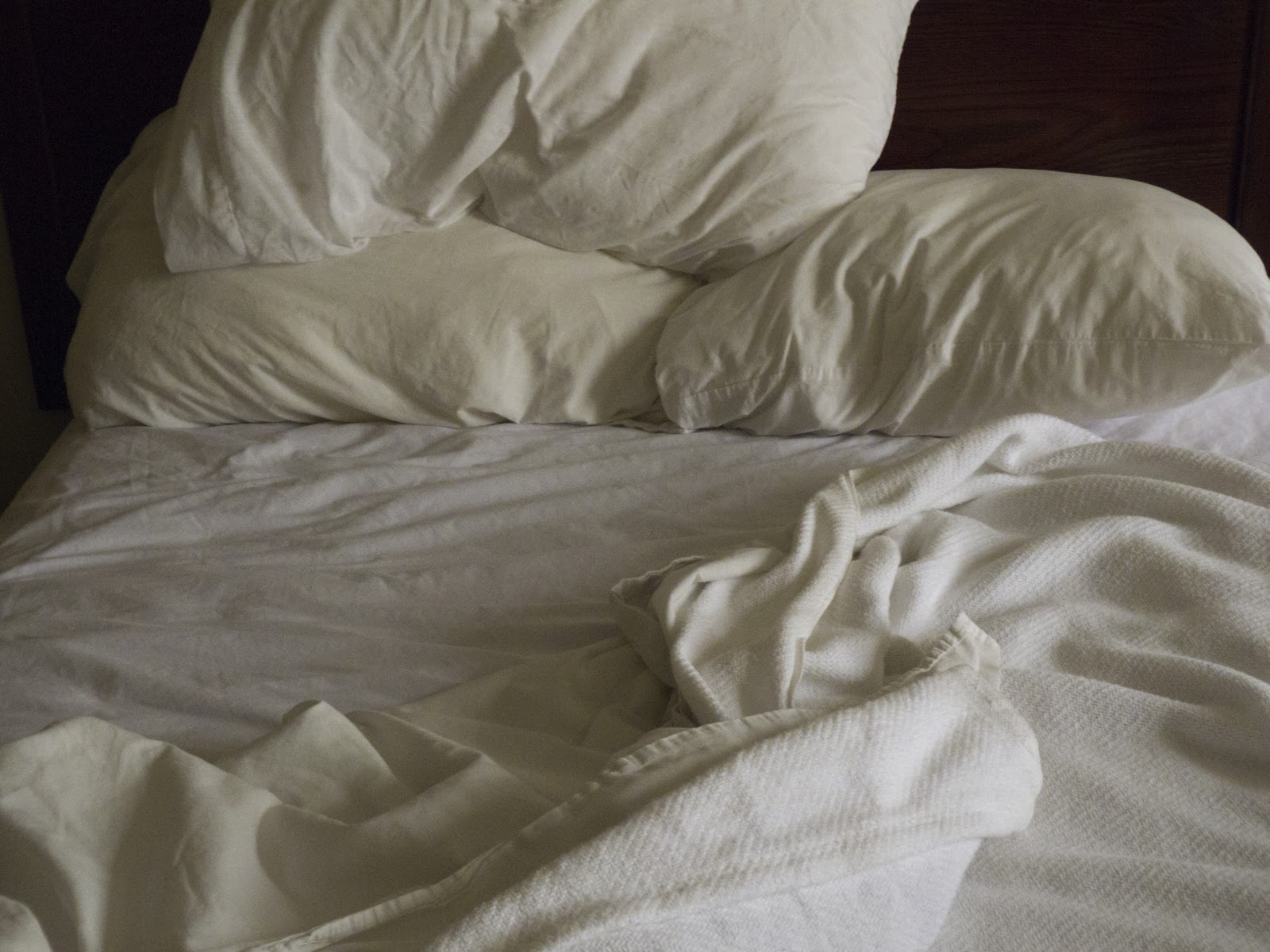
Photo: Hotel bed, Philadelphia, PA. April 2011.
Wednesday, June 29, 2011
Real Estate Speculation
You never liked to be cold.
As soon as you died they came and took your things away.
(Yuppies’ trumpet).
Curtains beds sheets hassocks dressers rugs dresses shoes towels smocks scarves
--that infamous panama hat!—
boots umbrellas jackets your pea coat mules slippers and long lace up boots.
Estate sale.
They boxed your paintings—six donated to the local museum--then sold your horde of paint tubes and jugs on craigslist
rolls and cans of brushes bolts of raw canvas gessoed panels stretchers frames frameboxes buckets of turpentine pencils and pastels rulers glass belayers pliers hammers saws nails shears
--everything but the chalkboard you used to plan (wipe errors easily away!)
Gestalts and spectral surfaces buried here
When the plants died—who came to water them? Your executors? She’s in Ontario, he’s in Calgary—they tipped them out at the edge of the drive then stacked the pots beneath the stairs. Lumps of dry earth and brittle leaves.
(Chester L Stump Crust has joined a men’s group.)
They can’t wait to sell the house.
Anyone can see what they missed—
Gestalts and spectral surfaces buried here--
Yuppies’ trumpet scribbled on the wall or
a mouldering rind of cheese in the fridge
a half empty jug of orange juice a frozen chicken an open tin of salmon-flavoured catfood--where is your kitty anyway?
and that crude icon painted by your friend Fred. You bought it at the art fair just to encourage him—the title you figured worth $30
Chester L Stump Crust has joined a men’s group.
Silly junk of carmined wood stowed on the garage ledge with the spare key.
Your fingerprints span the doorframe trace rainbow patter on the thermostat dial.
You never liked to be cold.
These photos were taken at an estate sale property in Curteis Point, Vancouver Island, BC, June 2011.
The life of a painter imagined here is a fiction, and bears no relation to the life or works referenced in the photographs.
Saturday, January 1, 2011
Look Forward, Look Back
(A Short Pronouncement that Turns to Dialogue. And Citation.)
Look forward, look back: isn't that what we we do on this day? But why just this day, or yesterday, or during the intervening week between Christmas and New Year's, when news is on short rations and so simply recycles? Always so many questions we might ask, but don't:
Who knocks as the clock clangs, as the snow piles up, flake by flake?
Will I be the one who must answer?
Our beauty so fleeting it runs out like ice on a hot day.
How far do I have to run to avoid coming back?
--As if you could, you know.
"Death is all things we see awake; all we see asleep is sleep."
--I know that, that's Heraclitus. Just so you don't have the last word, here is another of his aphorisms:
"If all things turned to smoke, the nostrils would sort them out."
Or this: "The fairest order in the world is a heap of random sweepings."
--I knew you'd do that, get the last word.
But it wasn't me; it was Heraclitus.
And now it's you.
No, it's you.
Notes:
Heraclitis, Fragments LXXXIX, CXII and CXXV from Charles H. Kahn. The Art and Thought of Heraclitus: An Edition of the Fragments with Translation and Commentary. Cambridge: Cambridge UP, 1979.
Photo: Old Montreal through the side mirror
Monday, August 23, 2010
The Solace of Colour
Grief. And Grace. II
After Linus died, and the bees came--and the wind, pinning us into one harbour after another--I began to dream in colour. Marike and I would pack a lunch, bottles of water and gatorade, our swimsuits and snorkeling gear, and paper, brushes and boxes of paint, and head to shore. We walked, swam, looked out to sea, and painted. What mattered, to me anyway, was not so much the quality of the final product, but the fact of making something, the layering of colour, like a laying on of hands in our hearts. Not healing exactly, but solar solace, a bouncing of light beams, a rendering of the world which rent us, at once awful and beautiful and more vast than we could tell.
Broken rocks for broken hearts.
Images
Watercolour sketches, San Juanico, BCS, Mexico, 18 March 2010
After Linus died, and the bees came--and the wind, pinning us into one harbour after another--I began to dream in colour. Marike and I would pack a lunch, bottles of water and gatorade, our swimsuits and snorkeling gear, and paper, brushes and boxes of paint, and head to shore. We walked, swam, looked out to sea, and painted. What mattered, to me anyway, was not so much the quality of the final product, but the fact of making something, the layering of colour, like a laying on of hands in our hearts. Not healing exactly, but solar solace, a bouncing of light beams, a rendering of the world which rent us, at once awful and beautiful and more vast than we could tell.
Broken rocks for broken hearts.
Images
Watercolour sketches, San Juanico, BCS, Mexico, 18 March 2010
Labels:
colour,
death,
death and life,
dreams,
grace,
grief,
Linus,
Mexico,
painting,
rendering,
rocks,
Sea of Cortez
Wednesday, August 11, 2010
On Not Having One Without the Other
That's one pair. Here are others: no visible light without shade to frame its contours, no life worth living without the companionship of and consciousness of death, no love, as Vicki Hearne puts it in writing about animal training, "without teeth."
I am writing a poetic note here, one that would deserve philosophical elaboration. That too will come, given time enough. But soon.
For now I am musing on this line: "Horror stories are told to relieve the teller of the burden of judgment." Also Vicki Hearne on dogs. She seems, I'd say, utterly right.
How do you tell a hard story so as to put horror in its place, firmly, rather than running amuck in the world?
That will be my next job here.
Horror and cowardice. They are also companion pieces.
Subscribe to:
Posts (Atom)