Saturday, October 22, 2016
On saying goodbye (when does death arrive?)
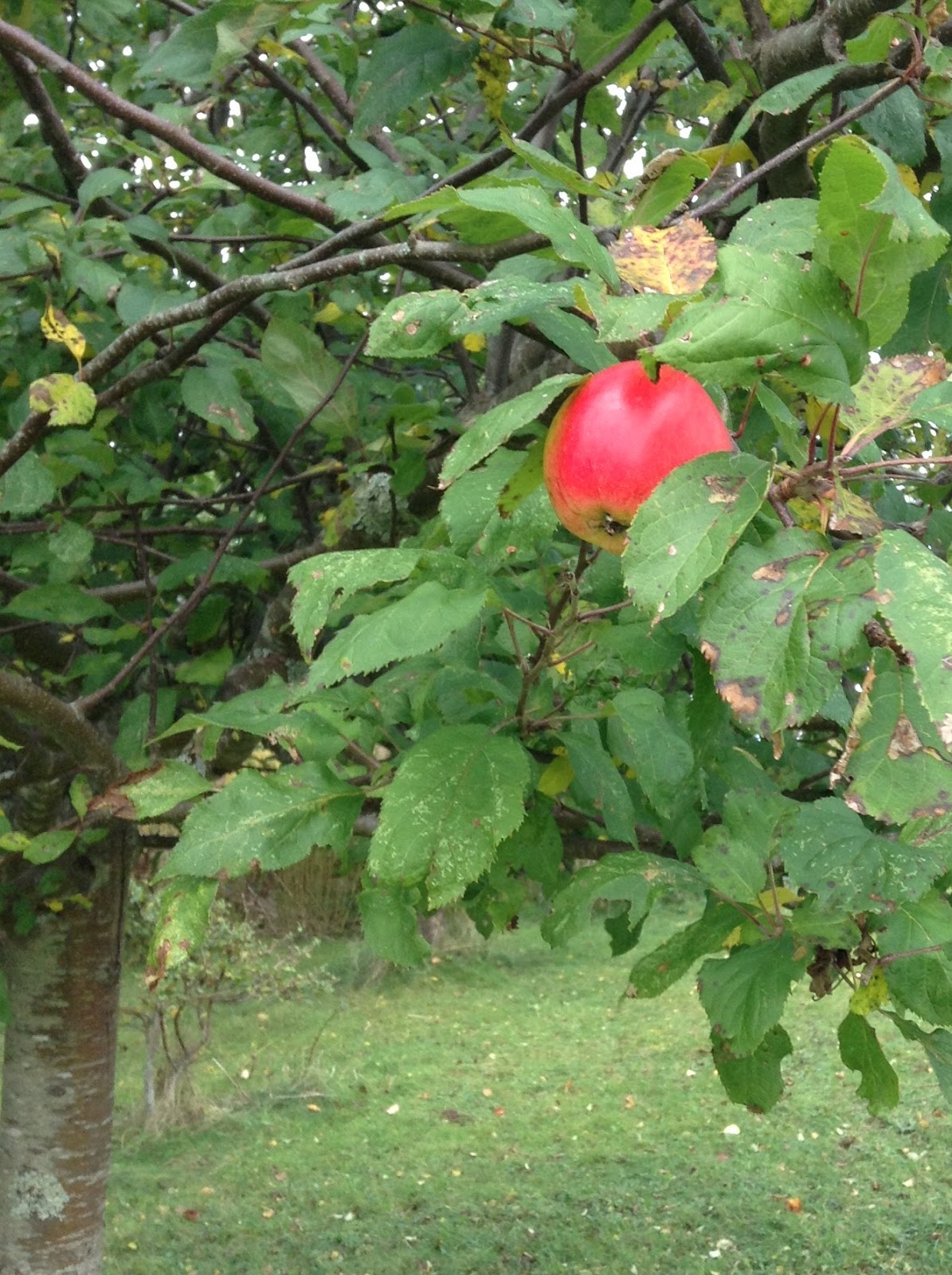
The morning arrives still, grey, humid. Offshore the sea blusters with a coming storm, but here the water is a claude glass, the air full of black flies. We swat them away as we walk out past the woodpile, up the slight incline to the barn, then along what used to be a fence line to the apple orchard. The apples aren't any sweeter, but they are redder, and some have begun to fall on the ground.
Past the weedy patch and the mound where the rhubarb grows, past the gangling burr oak with its few clinging brown leaves and then we are there beneath a birch and some spruces: our own private pet cemetery. We stop there briefly to speak to all our gone ones: in 17 years, the litany of names has become very long. Four dogs and now three cats and the ghost of a fourth haunt this grove, this section of stony earth. Enya, the new dog, who is almost two, sniffs the spot worriedly and then moves on, quickly, down the path to the pond. It is not a good place for living dogs to linger.
We buried our cat Dante there last week, after taking her to the vet for an overdose of sedative. In seconds, her poor stricken body, her paralyzed bent paws and stiff legs, the blind eyes and nictitating membranes that would not close relaxed. She bowed her head as if in sleep and all of the tension drained from her body. Her heart stopped and she was dead.
Sad as we were, as we watched her unfurl into death, we were also relieved, for her pain had become unbearable; despite her paralysis, she had tried again and again to run from what ailed her, only to fall, and her misery to worsen.
We'd had 17 years with her, our "big cat" as I called her, although she had always been small. Still, in the last year, as her kidneys failed, she had become tiny; two weeks ago, her legs weakened and began to stiffen. When I said goodbye to her on my way out the door to work that week, I thought it might be the last time I saw her.
She stopped drinking and eating that day, and because she kept falling, Marike took to carrying her around on a blanket or in her basket. She held Dante all night the Tuesday that I was in Halifax, and then when I came home Wednesday I did the same. We thought she died quite a bit that night, but was clearly still in pain. Mostly blind, mostly paralyzed, organs failing, her extremities--paws and ears--cold, only her tail still lively, impatient, expressive, switching and twitching, we bundled her in a blanket and took her to the vet, where a needle full of sedative slowly stilled her heart.
But is that when death arrives, when the heart stops or the autonomic nervous system ceases? Or does it settle in by degrees, as we who are living also let go, and the beloved body cools and stiffens?
I held Dante in my arms and petted her all the way home, speaking softly into that near space where it seemed her spirit, her particular character and being still hovered, touchable, keeping us company. We had not yet released our hold on her singular life, but what had been so lively and so alive without us now remained and shifted inward, circulating as memory and sensation and drifts of kitty fur, sewn through the cushions and corners of our lives.
In this way, she is not yet gone, but nestled into the forms of our gestures and habits. At night, in the dark, I still step carefully, as if she might be nearby, unseen, underfoot--as, in a way, she is. When I wake, I listen for her, sure I'll hear the drop of her paws on the floorboards, her soft purr as she climbs up on the bed, glad to have conscious company in the middle of the night. I put out my hand, curl my fingers around empty space. Likewise the dog curls on the bench by the fire, nuzzling a stuffed toy, sniffing at it as she did Dante, clearly missing her animal companion.
How does Rilke put it, the character of such missing and the way it shapes our lives? In the Eighth Duino Elegy he writes:
Here all is distance;
there it was breath. After that first home,
the second seems ambiguous and drafty...
Who has twisted us around like this, so that
no matter what we do, we are in the posture
of someone going away? Just as, upon
the farthest hill, which shows him his whole valley
one last time, he turns, stops lingers------,
so we live here, forever taking leave.
So we live here, forever taking leave of our loves--until the days that we, too, will die.
Unlike Rilke, I do not think that we live or die differently from other animals, although he might be right that we tend to busy ourselves with preoccupations, with objects, as he puts it, rather than "that pure space into which flowers endlessly open." But now and then, as death creases us, we too may turn or wake and look, not at life, but at something like being, as its wings beat by our heads. These too are gifts, as if from the dead to the living: look here; see; and hasten not your mourning.
Notes
Dante cat died on Thursday 13 October 2016. She had come to live with us when just a kitten sometime in the fall of 1999, a gift of Nicole Moser, who had heard we needed a mouser. We had two large black dogs at the time, Negrita, a black lab, and Binky, our three-legged wolfdog stray. Dante spent her first three days in the house on top of the kitchen cupboards; on the fourth day she descended, having somehow mesmerized the dogs, and despite her tiny size, whipped them into respect and obedience without ever extending a claw. In fact, that's how she got her name, for as Marike said, she was little, and needed a big name that was easy to hear and to call. Who better than after an exiled poet, who mapped heaven and hell and all of the regions between?
She was wise, scrappy, playful and clever--gave birth to five kittens, instructed Binky how to care for them rather than to eat them, and survived a neighbour's hate and traps, as well as an attack by roaming huskies that killed her daughter and wounded Elisabeth. Until a year ago, she kept the house free of mice and other small critters; she trained all of our dogs to be good to cats, and figured out that if she came and rubbed herself on our computers as we worked, she could be sure of nearly endless petting. She could play good jokes, sticking her paw in our water glasses, or dropping pellets of food in our shoes, and then watching to see how we'd react. And sometimes, when we played ball with a dog, she'd run interference, as if she could catch, but really to interrupt the dog's concentration, and make the ball drop. We'll not soon see her like again.
The Rilke I cite here is from Stephen Mitchell's translation and bilingual edition, Selected Poetry of Rainer Maria Rilke (New York: Random House, 1982): 195, 197.
Monday, October 26, 2015
What the dog's nose knows, or the art of noticing with the dog (art walk challenge #1)
![]() |
| A ripening apple |
Just as birds need to fly and deer need to run, we need to walk....to be happy.
Enrique Peñalosa, Mayor of Bogotá
Every place structures our perceptions; so too, does every sort of being. We all know this, and yet we rarely attend fully enough, in our daily lives, to the implications of such insights. While we might be quick to agree that what one notices while walking on a city street is dramatically different than what one hears or smells while out in the woods--the roar of traffic drowns out the subtle scrape of drying leaf against leaf in the breeze, or the lilt of birdsong--we're noticeably less willing to entertain other entities' or creatures' perceptual modes as a part of our own, unless we're trained observers of one sort or another.
And yet everyone who lives with a dog walks such a path daily: the dog regularly notices things we do not, and bit by bit, our association with a dog tunes our apperceptions to theirs. We see, by dint of daily walking together, that here, by this tree, is a particularly exciting scent, while that patch of grass there is somewhat frightening. The dog's responses begin to frame our own, even when we don't quite understand what is going on. For example, a friend who lives in urban Vancouver recently reported taking her dog, a young Great Dane, for a walk in the predawn morning. All of a sudden the dog began growling. My friend neither sensed nor saw the trouble, thought her dog had been somehow startled by a blowing leaf. And then the lights from a passing car illuminated a row of coyote eyes. Smart dog! writes my friend, relieved to have arrived back home safely.
![]() |
| Enya sniffs for field mice |
Often enough, what the dog senses is invisible to us, and thus appears somehow nonsensical, irrational, idiosyncratic. What might we see or understand, however, if we attempted to walk through the world guided not by our own imperatives, but by the dog's? And why stop there? Why not follow a deer path and learn to notice what a deer might? What about following a line of current, or the trajectory of a falling leaf? How would we walk through or map the world differently? What would we hear or smell or see otherwise? What novelties would strike us? How would our inner sensory and kinesthetic maps alter? Would our experience of walking, itself change, and how?
Leaving aside for now the great epistemological debates about what we might ever know of another being's ways of knowing (culture and learning suggest we can share something on this front,) and the challenge of tempering or overcoming our tendencies towards anthropocentrism, would or could a simple set of exercises--"art walks" say--begin to help us to attune ourselves to alternately lived (and thus possible) interactions in the worlds where we live?
Such questions led to what I am calling my "art walk challenge #1: while out for a walk, maybe with a dog, notice and document zones where two or more life forms enter into conflict, avoidance and/or collaboration."
![]() |
| we follow a deer path down to the water (pond) |
I made and annotated my own walk on and around the grounds where I live, in rural coastal Nova Scotia, and then invited others living elsewhere to do likewise. I offer a selection of notes from my walk, and others' responses below. As I read over the responses I've collected, I'm struck by how like poetry they are--perhaps because poetry too is an art of aerial or subterranean attunement, a mode in or by which one hears or notices things that pass above and below the threshold of ordinary experience. Does this mean that poetry, too, is an art of listening with the dog? (Or sometimes, perhaps, with the deer?)
![]() |
| orchard where the deer (dog and crows) graze |
My notes from Art Walk Challenge #1 (24 October 2015) are as follows: "Here, the deer avail themselves of apples from our trees and walk on paths that we've made. But we also follow deer trails to the pond (human made) and through the woods. The dog follows other deer paths, munches on crab legs dropped by gulls, digs in mouse holes, chases grouse. We come across a rat's nest a neighbour has tossed from a barn. Dog drinks from ditches and at the edge of the bog."
![]() |
| Enya crunches up the remains of a crab where a gull dropped the carcass on the rocks in order to break it open |
![]() | |
| pond edge where one deer path ends |
![]() |
| found on a neighbour's land: tossed out rat's nest |
Friends responded as follows:
Thanks gulls!"
'Here's my deerstalker scenting prey in the urban wilderness:"
I note that Faizal's remembered walk documents not simply encounters or collaborations (don't the quail sometimes draw the dog on, and work to decoy it from a nest or another sensitive area?) but potential conflicts between his dog and quail (finding, flushing out and possibly killing birds in the dark), and potential conflicts between doggish pleasures and the law, which is to say, between the law and the dog's human companion (punishable by removal and death of the dog.)
Who knew that a simple walk could uncover so much? And doesn't it always, if we've attuned ourselves to notice?
Of course, the sort of "tuning" I'm describing here, and asking my friends and readers to consider practicing, is not always so romantic. It is also a deep part of our social and historical experience, now muted by urban habits, the comforts of modern shelters and our typical patterns of consumption. A good hunter or a nomad for example, (whether human or non human) regularly must perceive as another does in order to survive. But then, so do children, any creature that is lost, or any person or creature who lives without adequate shelter or food. Nervy and alarmed, we learn to read others' patterns and pathways, and to map out escape routes and diversions, as well as others' garbage dumps.
From where I sit, in rural Nova Scotia, I cannot truly walk the routes taken by Syrian refugees as they flee the shifting and hostile landscapes of war and asylum. But I can begin to imagine these routes, in all of their heart-thumping horror and impossible hope--and indeed I must, and by so imagining be driven to act, if I am going to maintain that social awareness does any good good at all.
![]() | |||
| Looking towards the back of the pond where sea ducks nest |
Sunday, January 12, 2014
Hurt birds (on the politics of blame)
I wake from a dream in which small birds are fluttering into my hands. They are the size of finches, but coloured in blues and rusts and creams, as if they were swallows. I place each bird on a scarred round wooden table beneath a tall window and they gather in a huddle. It is cold. We seem to be at one end of a large library: musty volumes line the walls and the space is hushed and dark. Outside, it is winter, and bare branches scratch at the window. One detail stays with me as I wake--just before setting down each bird, I pluck a few feathers from its wings. This seems to frighten them, and hurt them; I do not know why I do it. Waking more fully, I realize that the cat is asleep on my chest. This has happened to me before--am I having her dreams again? She lifts her head and blinks at me.
No, let me own my own cruelty. I should not blame it on the cat.
Wednesday, November 13, 2013
A loon, a wolf, the loneliest sound
Why does the cry of a loon affect us so? Why does a wolf's howl, even while it raises hairs on the back of your neck, curl into your heart, slide into your bones and organs and resonate, as if an extension of your own loneliest wail? Do such cries seem metaphors for our sense of aloneness because we tend to hear them, if we do, in isolated wilderness locations--a cold wind blowing across the water, no one else in sight? Or is there some other reason for the way these calls seem to vibrate in your chest and threaten to carry you away?
This summer, while sailing in Alaska, I began to read a thoughtful, beautiful book entitled The Pine Island Paradox, having met its author, environmental philosopher, Kathleen Dean Moore, in the bathhouse at Tenakee Springs, on Chichagof Island. Two weeks earlier, I had been listening to and attempting to record the sounds of wolves howling back and forth across a great distance, so I was struck to find Dean Moore had a musical name for the particular haunting quality of a wolf's cry. She writes:
"I [know] the song the wolf [sings]. The first two tones [make] an augmented fourth, a dissonant interval, like the first two notes of 'Maria' in Westside Story. It's an interval of yearning, of hope--the sound of human longing."
Dean Moore writes about going to consult with a colleague who was a musician, a concert pianist. As they are speaking about this sound, her colleague makes a gesture: "both hands together in front of her body, palms skyward, fingers spread, [lifting] the air...'This is a sound that floods the soul,' she said."
Dean Moore recounts something else that her pianist colleague has told her, that in medieval Europe Christians did not sing the augmented fourth. It was considered the "diabolus in musica, the devil's chord--so powerful it could grab a parishioner, drag him to his knees and pull him, scraping on the paving stones, straight to hell."
A wolf's cry feels like this, and so does a loon's. Not the devil's music, but an utterly sorrowful heart-wrenching soul sound; it sings the anxiety of our lonesomeness at the same time as it can fill us with wonder or joy, even peace. Perhaps this is because we live in a time of great dissonance (although we might ask, which time is not?): we prefer the incompletion, the break of the augmented fourth to the harmonic fifth.
The augmented fourth somehow says, without you, I am nowhere, which is, often enough, how existing feels. It is the question posed by Rilke's First Duino Elegy: "If I cry out, who among the company of angels will hear me?"
It is the wail, addressed to the world in the absence of another beside you, of brokenness, of coming undone: myself, I am never enough; I will never add up to anything on my own.
Photo of the loon was taken in northern British Columbia, near Grenville Channel.
Wednesday, August 21, 2013
In Desolation Sound (Bathsheba's Poem)
Sharp rattle of relief:
rain patters in a dry place, gives a sense
of letting go. --Or sudden terror:
the sodden suck, the lack of
air, as if you're drowning.
Too much, too soon, a flood
of missing: blasted. Echoless. O grief.
Rain drums against taut canvas
sighs joy and lamentation, signs
pinpricks heart's ease fur furrows ear flaps dog's paws
sings the scent of grass upon her feet.
We tumble into fog into
seal's slap and wolfish wail, blind
to what they see or know. So near,
so far; too late to bring you home.
Teakerne Arm, 14 August 2013
Bathsheba b. 16 August 2002 d. 12 August 2013
Photos are of Bathsheba swimming at Psyche Beach, Taylor's Head Provincial Park, Nova Scotia, one of her favourite places on earth.
Bathsheba suffered the rupture of a bloody tumor in her lungs on August 12 and had to be put down....just days before we got home to be with her. We are very very sad. Don't really believe we will return to a dog-empty house. Life. Feel....remiss. Lost. Missing. Enormous thanks to our friend Paulette, who loved Sheba profoundly, and was with her at the end.
Sunday, September 30, 2012
Voces paginarum/ Shouting words
own may pass
Sunday, March 11, 2012
Time Changes
Another clear cold day. The sea is frozen out to the headland; a skim of brittle, pockmarked ice creeps up the beach with the tide, and the pond is solid again. It snaps and groans and echoes in the cove, stretching and shifting beneath its closed skin.
The sun is high and bright and warm as it streams through the windows. A time change today. So early? I think. Already?
I remember when it happened in May, the second Sunday in May, which was--or is my memory failing me now?--also, often, Mother's Day. White or red carnations on everyone's breasts in church; white for those whose mothers had died, red for those whose mothers were still alive. Why then do I remember my own mother wearing a white carnation?
It couldn't have been so; her mother was still vibrant, active, a nearly daily force in our lives. We'd go see her later that day for a big supper, and play badminton in her back yard, careful not to trample her garden, the petunias velvety, nodding, colourful, like playful tiny faces. I always wanted to touch them.
May in Columbus, Ohio was sometimes cool, cooler than April--too cold for short skirts and knee socks--but spring was out full blast by then, the trees leafy, gardens in full bloom. And now and then it could even be hot.
I catch a whiff of the smell of freshly mown grass (a Saturday job in those days, not a Sunday one); I recall the wood stacked neatly in a sparse pile along one edge of our grandparents' backyard, everything clean and in good working order, neatly organized--not like at our house. A sudden downpour, notes of spice and musk in the perfumes on my grandmother's dresser, bottles ranged and doubled on a mirrored tray. Perhaps this is why I treasure the scent and colour of amber? The ticking of the clocks; the cardinals at the birdfeeder; the large dial thermometer nailed to the maple tree.
Marike comes downstairs and opens the door. Cool air streams into the house and I am suddenly back in Nova Scotia. Still, even here, the birds have begun to call and sing from the trees. The last couple of days have been mild and everyone is expectant. Spring will be here soon they say.
I find this funny. I'm going on my nineteenth year in Canada, and I've grown used to waiting so long for the spring to come, that I hardly believe any of these signs. I'm not sure winter has truly arrived yet--I keep waiting for it to get worse, for here, on the shore, March is the bitterest month; the time when the surface temperature of the sea reaches its nadir.
But perhaps, this year, we are already there. Is this false hope brought about by an exceedingly early time change? What happened to bring it on so early? Or are my memories of my childhood faulty? Even here the animals are already shedding, the birds singing, the ground muddy and earthy smelling. Two days ago we startled an otter in the marsh at high tide; it watched us through a hole in the ice, and then swam to another hole and popped up again and again, growling a little each time, before swimming out through the culvert and into the bay.
Perhaps the earth and these creatures know something I don't. All along the shore streams rush and tumble into the water, sweeping away ice and stones and mud. The sap has been flowing all week too--a friend in Cape Breton is sugaring off.
I count the weeks: a bit more than a month of this term left. I take a deep breath: relief--or oxygen--reaches all the way to my toes. Just then the ice on the pond flexes, hisses, growls; it sounds just like an enormous outdoor belly. Hungry. I am, too.
Images:
Birthday tulips--March 2012.
My mother sends me a snapshot of a vase of forsythia she's brought indoors and forced. An early March practice in Ohio, early May in Nova Scotia. Photo by Marcia Cope, St. Paris Ohio.
Saturday, December 31, 2011
Shooting Ducks
As the year began, so it ends, in darkness.
Rain all day, and then wind and waves, pushing rinds of rotten ice into shore. Out with the old....
In a day or two the sea will freeze over again.
The morning begins with gunshots--a hunter motors out beyond the skim of ice in an aluminum skiff. He wears desert fatigues to stand over the sea and fire at ducks. Unlucky birds! Targets as soon as their plumage brightens for mating. They're no good for eating, these "fish ducks" as they're called; those feathers are destined to be trophies, stuffed and hung on the wall. A whole industry of memory, monuments to successful aim, sophisticated scopes, his practiced trigger finger.
I'm perhaps no different, hanging out the latest shutter trapped colours, little shreds of recollection: one place and then another: I was here, hymning to the light.
Still, shooting done my way preserves the ducks, in light as in flight, for another day.
Tuesday, September 28, 2010
Muzzling, or Where Does Creative Thinking Really Happen?
Several weeks ago, back before the hurricane, before the summer skidded abruptly into autumn, before the fog and rain and shriveled brown leaves became a part of the surround, I got up one morning and thought about the day, and the night before:
Hazy pink morning, the sea grey. The sun a red ball. Still. We wake in the night and fret: the stillness is eerie, unsettling. The owl at the back of the pond hoots into the silence: Hoo! Hoo! Hoo! Hoo! again and again. Why does the owl sing at night? Marike asks. And why the same song over and over?
This question, as soon as she asked it, as soon as I recorded it, inspired another sort of mimic hooting in me: for it set lines from Wordsworth's Prelude to echoing so loudly in my head, that I had to run to the shelf and begin paging through the volume of poetry just to still their rant. (Or is it cant? What theory of the origin of language is here?)
Here, so you can still the echoes in your own head--or begin to hear them if they don't already rattle--is Wordsworth:
There was a Boy, ye knew him well, ye Cliffs
And Islands of Winander! many a time
At evening, when the stars had just begun
To move along the edges of the hills,
Rising or setting, would he stand alone
Beneath the trees, or by the glimmering Lake,
And there, with fingers interwove, both hands
Pressed closely, palm to palm, and to his mouth
Uplifted, he, as through an instrument,
Blew mimic hootings to the silent owls
That they might answer him. --And they would shout
Across the wat'ry Vale, and shout again,
Responsive to his call, with quivering peals,
And long haloos, and screams, and echoes loud
Redoubled and redoubled; concourse wild
Of mirth and jocund din! And when it chanced
That pauses of deep silence mocked his skill,
Then sometimes, in that silence, while he hung
Listening, a gentle shock of mild surprize
Has carried far into his heart the voice
Of mountain torrents; or the visible scene
Would enter unawares into his mind
With all its solemn imagery, its rocks,
Its woods, and that uncertain Heaven, received
Into the bosom of the steady Lake...(Prelude Book V: 389-412)
Why does the owl sing the same song over and over? And why are we so drawn to imitate it? Surely Wordsworth is somehow right--this imitation of nature--this play of mimicry back and forth, this enthusiasm for such exchanges must be at the origins of our language, our poetry... In any case, I've been musing on these questions ever since.
In fact, in a strange and perhaps altogether predictably repetitive twist, I've been musing on the word musing.
Wonder where that word comes from? Marike asked, and so one night after dinner I pulled out the dictionaries--an old compact Oxford English that belonged to her father (1934) and Skeat's Etymological Dictionary of the English Language (c. 1900). Muse, I mused, must be related to light-heartedness, to amusing. Perhaps. But not quite.
The etymology of muse is far more beautiful than that. And perhaps it answers to why we are given to such mimic hootings of, and wild concourse with the animals around us. Not because they inspire us, in the way of the nine Muses of classical mythology. That strain of the word is descended from the Greek Mousa, which shares the root men-, or mon-, with other words denoting to think, to remember. But muse, as I marked it, meaning to wander about in your thoughts--or as the Oxford dictionary would have it, "to ponder, reflect, gaze upon meditatively..." this muse derives, it seems, from the Old French muse, or MUZZLE, which is to say, to "sniff the air when in doubt about scent."
Or as Skeat argues it, the word comes into English from the "F[rench], muser, 'to muse, dreame'." Before that, he says, one finds the roots of the word in the Old French muse meaning "the mouth, muzzle....The image is that of a dog sniffing the air when in doubt as to the scent; cf Ital[ian] musare, to muse, also to gape about, 'to hould ones musle or snout in the aire' Florio, from Ital[ian] muso, snout" (Capricorn Edition, 1963, 341).
Now that's a beautiful etymology! The origins of creative thinking found, not in sight or hearing, but in what--or more properly, the way--a dog sniffs the air.
We often say, as we watch the dog scent out the messages left in the yard overnight, that she is reading the morning news. Indeed. And all my mimic hooting, here, is only that, a weak, attenuated imitation of the dog's MUZZLE.
--Which is to say--if you follow out that etymology--TO BITE.
But more on that--the link between thinking, creating and aggression (or between people and dogs)--another day.
Friday, August 20, 2010
Grief. And Grace
Sudden and sharp, grief cleaves us as if cleanly, but the wound is forever jagged.
You never get over sorrowing after a creature who once clung, closely, to your skin, who huddled in the curve of your hip, who attended your waking and sleeping and sickness and joy. "Nurse kitty," we called her, after her habit of looking after all of us, her closeness, her attentiveness, her insistence on grooming every one of us, licking the hairs of our heads into place.
All of us miss her in acute and particular ways, including her closest friend, dog Bathsheba, who fell into a profound and terrorized depression when Linus died; for days and months it seemed, Sheba sank wearily onto her bed, limbs cracking and creaking. Big sighs: nothing in the world seemed to count anymore. We worried that she might give up too soon, herself, on living.
But here, the end of the summer, and we do all go on, managing now joy and not (always) nightmares. It has taken months for me to muster the courage to tell this story.
I think again and again of the last lines in Toni Morrison's Sula, when one character realizes, years later, just how much she has missed her friend. Sorrow has dogged her, hovered just out of sight, like a little ball, off to one side of her head. But she never turns to look at it. And then one day dead awakens, becomes memory, words, then "not even words. Wishes, longings...A soft ball of fur [breaks] and [scatters] like dandelion spores in the breeze." The loss of her friend Sula presses down upon Nel and she cries out. Morrison's story ends here, with this description of uncontainable grief: "It was a fine cry--loud and long--but it had no bottom and it had no top, just circles and circles of sorrow." Here is something I know--we know--in living with our surviving animals after the trauma of Linus's death: Rilke got it wrong. So too did Levinas. Not only "our eyes are turned backward..." Any animal, and not only humans, is
twisted around like this, so that
no matter what we do, we are in the posture
of someone going away...Just as, upon
the farthest hill, which shows him his whole valley
one last time, he turns, stops, lingers--,
so we live here, forever taking leave.
(Rainer Maria Rilke, Duino Elegies, VIII, trans. Stephen Mitchell)
We all have faces, inward looking eyes; all of us know something of our own mortality. If you doubt this, go sit in a vet's office where animals are daily put to death and watch them, even the most aged and lame, resist crossing the threshold--or else pass, head down, already resigned to the death sentence. Look into the eyes of cattle destined for slaughter and see if you don't recognize there, that "recognition of mortality" Levinas believed was so crucial to having a "face" that could command the ethical imperative, "thou shalt not kill." --But enough of this; already I am off topic. These are arguments for another day. What I wanted to talk about was grief. And grace.
Here, notes from my journal, a sequence of days.
"And then, about half way through our long captivity, for a few short
weeks, before the sentinels chased him away, a wandering dog entered
our lives. One day he came to meet this rabble as we returned under
guard from work. He survived in some wild patch in the region of the
camp. But we called him Bobby, an exotic name, as one does with a
cherished dog. He would appear at morning assembly and was waiting
for us as we returned, jumping up and down and barking in delight.
For him, there was no doubt that we were men." 153) Levinas, Emmanuel. "The Name of a Dog, or Natural Rights." Difficult Freedom: Essays on Judaism. Trans. Sean Hand. London: Athlone, 1990. 151-53.Friday, May 15, 2009
Animal Life
11 May 2009
Isla Coronados
I think I saw a blue whale fishing and blowing in the channel this morning.
We were wakened by the usual sunrise breakfast run. At the foot of the cove, dozens of dolphins splashed and rolled and fed and dove and squealed and exhaled, one dolphin repeatedly coughing, kamikaze pelicans adding to the fray. And then out in the channel, I heard a very loud, very deep exhalation, then another—and looked up just in time to see the dark form roll into a long slow dive. All morning, all around us, the feeding continued. The whale’s breathing awoke Marike; she stuck her head up through the companionway to see what she thought must be a dolphin right next to the boat.
Isla Coronados is a seagull rookery. Yesterday, we visited all of the beaches around the cove by dinghy. On one, as Marike walked towards the end of the beach, every gull in the area rose up and flew at her, crying out.
Just above the tide-line, we could see the gulls' nests, shallow indentations in the sand ringed about with bits of seaweed and downy fluff. Rays skittered through the water, fleeing our shadows, and here and there, in the volcanic stone-pile reefs at either end of the beaches, brightly-coloured angel fish and black fish with brilliant orange tails swam. I even saw a large eel.
All around, we hear the birds call; the cackling of the gulls is most constant, but overhead, ospreys screech and pelicans flap their wings, and closer to shore, songbirds chirp and sing. And all around, hundreds and hundreds of tiny grebes swim and dive.
It makes me happy to see all of these animals, even to see them squabble. Yesterday, on our way here, we saw a very self-satisfied gull paddling about with a huge gob of fish in its beak—so large it couldn’t swallow. The gull paraded about like a lab with a ball in its mouth. Finally it dropped the chunk into the sea, nipped a bite and picked it up again—at which point a frigate bird noticed and began diving at the seagull. In seconds, two blue-footed boobies were in on the action—all three larger birds menaced the gull until it finally lost its nerve and some of its meal to the frigate bird.
The law of the sea is not just “survival of the fittest.” It is also, “you shall share, whether you want to or not.” For example, in San Juanico, while we were playing and painting on shore, mud wasps began to build elaborate cone-shaped nests on our boats: colonizing the colonizers. On Isla Coronados, thirsty bees threw themselves into our paints and water, and while we were anchored in Ballandra Cove, dozens of wasps sipped from the dripping edges and waterlogged terry nubs of our washcloths. We have no choice but to share, to become a bit less frightened of stinging insects. Water is what they want, not blood.
Images:
Quoddy’s Run underway
Pelican swims in shallow near Isla Coronado